In an article on Mashable which I read today, the author’s argument is that how we search can tell us a lot about how we feel about the search object or subject. Basically, researchers are now conducting rhetorical analyses of the most commonly searched terms and how they are written in order to understand better how a country’s internet users skew on a number of diverse subjects: products, brands, services; and more recently now: race, ethnicity, socio-economics, politics, etc. The article is entitled, Search Stereotypes: What Web Content Reveals About Cultural Biases, and it most closely examines how Latinas are depicted in the context of search terminology.

This is very interesting to me, and it’s a large reason why I still believe a career in search marketing or search analytics would be incredibly edifying and interesting, especially at the sociological level. What new more socially and culturally oriented organizations are trying to do is to manually re-adjust those perceptions through the same media that the information is coming to them on.

As the author, Sandra Ordonez, writes “The online stereotype of the hyper-sexualized Latina is simply not true. Statistically, most Latinas are the exact opposite: smart moms with families. This is exactly why we launched Mamiverse — to fill the websphere with more content that is truly reflective of who we are,” Martinez said. It’s basically fighting fire with fire- analyzing search engine content for racial, sexual and cultural bias and then manipulating search results in the name of promoting a social cause, rather than for a product or company, and they’re calling it “Content Activism.”

Many months ago now I wrote about sentiment analysis and the Affective Norms for English Language index that allows for this type of rhetorical analysis. This approach has been applied to Twitter and the search engine optimization/marketing fields for use in better targeting and improving public brands in the public view.

Basically it all comes down to diction- word choice. Whether we each think about it every day or not, the choices we make in vocabulary to describe things can tell our audiences a lot about how we feel about the things we are describing. Additionally, whether we think about it or not, every time we type a word or search term into a Google box, we are sending a transmission to an audience that will never disappear. The ongoing record of data and information that Google represents is like a sandbox for academics, and a historical record for the rest of us. That, in itself, is a striking image.

The article lists a number of racialized and gendered search terms and their most commonly returned meta search terms- a table which I found very interesting:

Top Three Search Results and Suggested Group Information


The following descriptions are based solely on meta site descriptions found after each title. The actual sites returned were not visited. This is only a sample of searches conducted.

  • Latinas: All three results are pornographic. Descriptors include “hot,” “young” and “legs wide open.” Seems to hint that women on 8th street, a historic street in an internationally-known Latin neighborhood in Miami, are sexy and “doable.” (Search for Latin women results in various dating sites for men seeking Latin women).
  • Latin Men: Since “Latinos” is used to describe an entire group of people, we used the term “Latin men.” One link is for a site that helps you secure a stripper or exotic dancer. The other two links are porn sites. Descriptors are a bit too pornographic to list in this article.
  • Asian Men: Two links for the “Angry Asian Man” blog and an article exploring whether Asian men are good in bed. Only descriptors are found in one sentence that directly addresses stereotype: “We all know the stories about Asian men’s sexual prowess, or the lack thereof, and the age old jokes about the ‘size issue.’”
  • Asian Women: Two links for organizations that provide Asian women with domestic violence support (NYAWC and SAKHI) and a dating/marriage site for single men looking for both Asian women and Asian girls. Only descriptor includes the word “survivor.”
  • Black Men: A Wikipedia article describing the term “black men,” an article explaining why white women prefer black men, and a link to Black Men Magazine, which seems to focus on pop culture and sexy women. No descriptors, but phrases include “racial” (comes up twice), “mugger button” and “Ink Candy Party.”
  • Black Women: A link to a “black women’s interracial marriage site,” a link to “Black Voices News and Opinion” on The Huffington Post and a Wikipedia article describing the term “black people.” Descriptors include “slaves” and “enslavers,” with a sentence describing them as “surviving.”

I highly recommend checking out the article, which does a good job of acknowledging that the search results analysis is not an entirely accurate snapshot of the world’s views simply because it self-selects according to a higher echelon socio-economically. In other words, not everyone in the world has access to the Net, so the sample bias is definitely a source of some anguish in this budding field.

Still, the area of “Content Activism” connected with sentiment analysis is an interesting one- food for thought!


This morning I heard this story on NPR about the efforts to study and improve public perception of “reclaimed wastewater,” aka sterilized and filtered sewage water that has been cleaned for re-use by the public. It made me remember this story on NPR from last night about what we should call the current economic crisis. Both of these stories essentially address the oft-referenced “what’s in a name?” question, and it is a question that has spawned an enormous communications sub-industry known as “branding.”

From an intellectual standpoint, the discipline of branding is completely fascinating. It melds science and psychology with a worship of capitalism, and produces a proscriptive and insidious process for advertising and marketing to follow. The field of branding helps companies, organizations and these days, even human beings, to develop an aura of feeling around a name, product, or icon. As Wikipedia puts it, “The American Marketing Association defines a brand as a ‘name, term, design, symbol, or any other feature that identifies one seller’s good or service as distinct from those of other sellers.’” For me, that definition is way too harmless.

You see, the way we feel about brands in modern America has been directly driven by the children and cohorts of Sigmund Freud. From Coca-Cola to Proctor & Gamble, Barack Obama to Apple; a good brand is worth billions and billions of dollars- and is a very high stakes business.

So here is where perhaps I should admit, I’m not a huge fan of branding. Though I am fascinated by it and by how powerful it can be, I also conversely often find it either insidious, or very fluffy. For instance, I often hearken back to my first job out of college where I was the account manager at my consultancy for a large tech storage company which shall remain nameless. When that company re-branded itself the client required that I and my account team attend their extensive briefing on the new brand. We sat through countless hours of presentations about the new “drivers” for the brand- items such as, “if this brand were a marine mammal what would it be? A dolphin!” “If this brand were a luxury airline, which would it be?” etc. The whole thing was such an utter waste of money and of time that I left feeling sick to my stomach. I was terrified that this was what a career in communications would lead to. Thankfully it didn’t, for me.

However, if done well, there really is a science to branding and re-branding. Some companies spend millions of dollars on U.S. census-level studies and data mining to discern what people will buy and what they won’t. In other words, once you’ve seen it on a shelf at Target, millions of dollars have probably gone into ensuring what is likely now a foregone conclusion- that you’ll buy it.

What does all of this have to do with reclaimed wastewater and the economic downturn, Jessica, you ask?

Well, taking the first topic on wastewater, the issue at the heart of this excellent NPR report is the very prominent problem of water sources in California. One of the theories and proposed solutions for water shortages in California has been wastewater recycling whereby plants would be built in California “that would clean local wastewater — aka sewage water — and after that cleaning, make it available as drinking water. “ There’s no rational reason that this shouldn’t be a stellar solution to California’s chronic droughts- if the water is 100% safe to drink, this is a phenomenal solution. The only real roadblock to moving forward with the plan? The public perception that the plan is for them to drink other people’s, er, waste.

As one of the leading professors who helped to draft the proposal, Brent Haddad, who teaches environmental studies at UC Santa Cruz attested, “The public wasn’t really examining the science involved,” Haddad says. “They were just saying no.”

Why? Because there was a complete lack of branding involved in proposing this plan to the public. They should have seen the public rejection of this coming from a mile away, especially given the utter germophobia and hypochondria the general public suffers from these days (just think about the rise of those anti-bacterial hand sanitizer bottles ).

Too often the science of branding isn’t applied where it could be most useful- moving the public to adopt new courses or policies that are agreed to be rational and most beneficial to the greater good, but that suffer from being completely distasteful given the contemporary political, social or cultural context.

In the case of the California wastewater proposal, rather than turning to a branding firm, Haddad turned to a group of psychologists for help. Enter Carol Nemeroff who works at the University of Southern Maine and studies an area of psychology known as “psychological contagion.” Still with me? Because this is where it gets really, really good.

“Psychological contagion,” or informally, “contagion thinking,” “refers to the habit we all have of thinking — consciously or not — that once something has had contact with another thing, their parts are in some way joined.” In other words, “psychological contagion” is all about how the human brain works to create lasting neural connections between two objects because of their relationship to each other. From here we are only one hop, step and a small jump from the principle of “brand identity,” where objects adopt and carry attributes of feeling or sentiment with them due to successful marketing and advertising ploys. The one item contaminates the other in our brain, and they are inextricably interlinked sometimes forever.

Nemeroff’s conclusion on the wastewater topic? “You need to change the identity of the water so that it’s not the same water. “It’s an identity issue, not a contents issue,” she says, “so you have to break that perception. The water you’re drinking has to not be the same water, in your mind, as that raw sewage going in.” Nemeroff suggested that the wastewater project managers find a way to more closely relate the purified wastewater with shared concepts of nature in order to purify the water not only in physical form, but also in its branded form for the general public. This is re-branding at its best, people. The water will be the same water, but you need to convince the public with all of the available branding bells and whistles that the water is different than it was before.

So here’s where we get to the topic of re-branding the current economy. The other NPR story from Marketplace addressed how the economic downturn is being branded, and therefore also perked my ears. This one struck me because I have felt myself grasping for a title for this strange economy, without any luck. Clearly I’m not alone, as the accompanying article to the story reads, “The subprime crisis, the credit crunch, the recession — all are clearly part of one enormous economic mess that, at the moment, is nameless. There’s no question that we’re living through a historic downturn. But what will we call it?”

NPR interviewed Jonathan Wald, senior vice president of business news at CNBC, about how they were referring to the economic period, and he admitted,

“it’s really hard when you’re in the middle of something to know what it will be called. So all you can do is brand the hell out of it. In the media, he says, if it’s not branded, it doesn’t exist”

We have “economic downturn,” we have “deficit,” we have “depression,” but none of those has really stuck. The “depression” is fairly easy to weed out of the running, since bankers aren’t out on the corner selling apples, and thanks to the infamous photographic record by Dorothea Lange, the images of economic hardship we are observing now don’t fit with the national collective memory of a “depression.”

It seems the general consensus is that a name for a historical period or economic trend only begins to take form in retrospect, as historians, journalists, novelists and documentarians begin to need a commonly acknowledged term to indicate their subject matter. I guess we’re just not there yet.

I am not an economist by any stretch of the imagination, but I know enough cursorily about investor confidence to know that a brilliant brandsman or woman could easily re-brand this current economic situation into something less threatening for us all and most likely do the economy some favors in the process.

If we could all be assured that this is NOT a “depression,” or “devastation,” but rather a “temporary lull,” or a “cyclical recession,” it would be akin to the very act of taking wastewater and forcing us all to drink recycled sewage- and to feel good about doing so. Not the most palatable idea, but in the public’s best interest in order to move on.


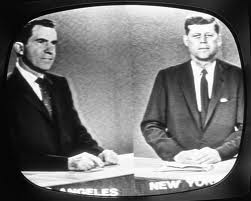
Any student of communications worth his or her salt will have studied the infamous Nixon-Kennedy Presidential debates of 1960. Why? Because they were the first ever televised presidential debates, and they marked an inflection point in American politics, where hearts and minds were not won merely by talented rhetoricians and charming radio personalities, but increasingly by physical appearances and a demonstrated ease in front of a camera.

As the story goes, Nixon was ugly and evil looking normally, but on the date of the first of the four debates he would have with Kennedy, his physical appearance was worse than usual: “Nixon had seriously injured his knee and spent two weeks in the hospital. By the time of the first debate he was still twenty pounds underweight, his pallor still poor. He arrived at the debate in an ill-fitting shirt, and refused make-up to improve his color and lighten his perpetual ‘5:00 o’clock shadow.’” I think we can all imagine.

However, Kennedy’s appearance was another story, “Kennedy, by contrast, had spent early September campaigning in California. He was tan and confident and well-rested. ‘I had never seen him looking so fit,’ Nixon later wrote.”

Whether Kennedy’s handlers were much more prophetic about the impact of TV, or whether Kennedy just lucked out, we may never know. What we do know is that Kennedy’s appearance on TV during that debate changed the path of American politics forever. A majority of Americans who listened to the debate solely via radio pronounced Nixon the winner. A majority of the over 70 million who watched the televised debate pronounced Kennedy the easy winner.

Are you beginning to see why this appeals to comms geeks? The suggestion that a newly introduced medium could so profoundly impact the perspectives of so many people in the context of a very high stakes popularity contest was tantalizing. It remains tantalizing today.

Fast forward 51 years to Obama conducting a Townhall meeting streaming on Facebook, and to GOP Presidential candidates using Twitter and Facebook metrics to potentially supplant traditionally collected polling information.

What would happen if you could use Twitter, Facebook or good old Google Analytics to accurately predict the outcome of the 2010 Presidential Election? Some growing social media analytics companies such as Likester are doing just that by measuring the uptick in popularity of pages and social networking presences. In fact, Likester accurately predicted this year’s American Idol winner way back in April.

But how scientific is this data, and what exactly is being measured? As Mashable reports, Likester mostly measures popularity and predicts winners based on the aggregation of “likes” on Facebook in concert with high-profile events. For the GOP debate, “The stand-out frontrunner was Mitt Romney, who ended the night with the greatest number of new Facebook Likes and the greatest overall Likes on his Page.” As we can see, Likester basically began the ticker right when the debate began and distinguished between unique “likes,” or “likes” that occurred after the debate had started, from overall likes. In the end Romney had 19,658 unique or new “likes” during the debate, resulting in 955,748 total “likes,” representing a 2.06% increase in overall “likes” during and directly following the televised debate.

Likester reported, “Michelle Bachmann ranked second in the number of new Likes on her Facebook Page.” In numbers that came out to 9,232 unique or new “likes,” 326,225 total, representing a 2.75% increase.

Care of nation.foxnews.com

Naturally, AdWeek threw their two cents into the discussion, arguing:

“Polling has always been an important element to any electoral bid, but now a new type of impromptu assessment is coming to the fore. Third parties, such as analytics startup Likester, are carving out a space for themselves by processing data that is instantaneously available.”

I’ll give you instantaneously available, but, again, how scientific is this? After all, no one seems to be taking into account what I would call the “hipster correlate.” The hipster correlate is the number of Facebook users who would have “liked” a Romney or Bachmann or Ron Paul page in a stab at some hipster-ish irony, thus proving to those who check their Facebook page or read their status updates their outstanding skills of irony in becoming a fan of a Tea Partier web page, etc. If we’re really doing statistical regressions here, what’s the margin of error here, Likester?

Additionally, how closely can we attach the fidelity of someone who “likes” a Facebook page to a living, breathing politician? On my Facebook page I think I have “liked” mayonnaise, but if there were to be a vote between mayo and ketchup to determine which condiment would become the new official condiment of the U.S., would I necessarily vote mayo? That’s actually kind of a crap analogy, but you get what I mean.

Before we are forced to read more blogs and news articles (like this one!) pronouncing exit polls dead and Facebook and Twitter as the new polling media, I’d like to see a very solid research study conducted as to how closely becoming a fan of a political Facebook page correlates to Americans’ actual voting behavior. In other, more web-based marketing terms, what’s the voting conversion rate for political Facebook pages?

Has anyone seen anything like that?

In other words, please, social scientists and pollsters, show us whether yet another new medium is disrupting the way that Americans individually see and interact with their political candidates, and how that medium has begun to shape the way those political candidates are regarded by an American audience as a whole.


OK, stay with me, because this entry will be jam-packed with seemingly unrelated elements, but I promise (hope?) it will all come together in the end.

In today’s NYTimes Thomas Friedman wrote an open letter to Chinese President Hu Jintao called “Advice for China.” In the open letter, Friedman asserts that Jintao had asked for impressions about what has now been termed the Arab Spring (I wish that I were creative enough to attach a pre-landing page to that link that first asked, “Seriously? You don’t know what this is?” ).

In his column, Friedman reports,

“Our conclusion is that the revolutions in the Arab world contain some important lessons for the rule of the Chinese Communist Party, because what this contagion reveals is something very new about of how revolutions unfold in the 21st century and something very old about why they explode.”

As you can imagine, this particular article is chock full of rhetoric about how social media platforms like Facebook and Twitter are changing the way that revolutions are born, are changing the way revolutionaries connect, etc. Read the article if you want the whole gist.

What stuck out for me in here was:

“The second trend we see in the Arab Spring is a manifestation of ‘Carlson’s Law,’ posited by Curtis Carlson, the C.E.O. of SRI International, in Silicon Valley, which states that: ‘In a world where so many people now have access to education and cheap tools of innovation, innovation that happens from the bottom up tends to be chaotic but smart. Innovation that happens from the top down tends to be orderly but dumb.’ As a result, says Carlson, the sweet spot for innovation today is “moving down,” closer to the people, not up, because all the people together are smarter than anyone alone and all the people now have the tools to invent and collaborate.”

As someone who read Surowiecki’s “Wisdom of Crowds” and found it to be such a breathtakingly accurate portrait of why social media matters in a modern political context, this paragraph really struck me. I guess I’m wondering if we have, in fact, all agreed that “all the people together are smarter than any one alone.”

Care of noobpreneur.com

I mean, I have personally read enough to be convinced that such a statement is quite accurate, despite my fears of groupthink and a mob mentality, I can see now very real and very tangible examples of why democracy is actually better than any other style of government (note please that I say better, not perfect). But have we all agreed on that?

I’m particularly inclined to believe in democracy as the best-yet model for government not only against the backdrop of what has been happening in the Arab world, but also because I have been reading up on my insects (cue the confused silence of the readers- Really? I thought that was an excellent segue).

Peter Miller’s “Smart Swarm,” is a great book for any communication or ‘wisdom of crowds’ geek. The book is sub-titled, “What ants, bees, fish, and smart swarms can teach us about communication, organization, and decision-making” and boy has it been teaching me a few things.

So far I’ve read about the fascinating networks and collaborative processes which exist inherently within colonies of bees, ants and termites. Difficult tasks such as locating new shelter, finding and foraging for food, and building a geometrically (and one might even say architecturally) complex living vessel are undertaken and achieved on a daily basis by insects to whom we ascribe the smallest of intellectual abilities. These insects all have different ways of building consensus about the best way to proceed. Bees have a special “figure 8” dance that they do in sequences at particular angles to ostensibly vote with a dancing fervor for their particular choice for the next nesting area. Ants leave scent trails behind them when striking out for food and the scent grows strong as more and more ants follow the same trail, collecting food and bringing it back to the rest of the colony.

“The Smart Swarm” basically goes to some lengths to offer a window onto how specific populations of insects and animals can offer clues as to how consensus and productivity may be alternatively achieved. The problem with humans, it would often seem, is that we have these big brains and these big mouths. Both of those things often get in the way of us agreeing, and on getting things done.

Care of brainz.org

The principle behind all of these comparisons between insects and humans is the study of biomimicry, which, as Wikipedia describes, is “the examination of nature, its models, systems, processes, and elements to emulate or take inspiration from in order to solve human problems.” For example, velcro is one of biomimicry’s earliest and most infamous products. [Would anyone like to go down the rabbit hole with me on this: please provide any comments or feedback on how you think biomimicry is generally regarded as a cool, smart-people thing, but anthropomorphism is generally considered to be the realm of lunatics and cat ladies.]

For communication geeks who love to examine how different groups of people can get together to solve big problems, this stuff is gold. If you’re a real biomimicry zealot, the amazing and tantalizing fact of it is that nature holds all of the answers to our problems already, as long as you’re ready to go out and closely watch it play out. Which brings me back to this notion of the democratization of information, which Cesar Alierta writes about in Chapter 1.4 of the Global Information Technology Report.

In the chapter, Alierta focuses mainly on ICT as the platform which brings about the democratization of information. But in reality, if you follow biomimicologists(?) like Miller, information is already everywhere around us, in nature, just waiting to be plucked and used to solve problems. Alierta refers to the so-called “Solow Paradox,” which asserts that “there is a lag between investing in or deploying ICT and the generation of positive effects on productivity.” And he goes on to say “no less important (than ICT to productivity gains) is the extent to which the impact of new technologies in the social sphere benefits the entire economy.”

But as most of us know, the investment in resources such as ICT is often a top-down decision, so naturally, if Friedman’s assessment is to be believed, that “innovation that happens from the bottom up tends to be chaotic but smart. Innovation that happens from the top down tends to be orderly but dumb” we’re constantly giving the purse strings and the power to invest in better innovation to the wrong folks.

A hive of bees leaves the decision of where to locate the next hive squarely in the capable hands (wings?) of drone worker bees to go out in search of suitable locations and come back and perform a vigorous dance for the location of their choice until a decision is made through consensus. A colony of ants puts the decision for where and how to find food for the colony solidly in the hands of its forager ants, and as they forge new trails and leave their scents behind, more and more ants find and retrace those steps, making the scent stronger and stronger and creating consensus in that fashion. The difference is, these are largely decentralized systems of building consensus, making decisions, and acting in favor of the greater good.

Which all brings me back to Friedman’s assessment of the use of social networking and messaging platforms during the incredible revolutions of the Arab Spring! As Alierta writes in Chapter 1.4 of the Global information technology Report, “technological change has not led to a progressive isolation of the individual. Instead, technology is facilitating the emergence of how forms of interaction- among individuals, groups, and companies- creating a new kind of cooperative that overcomes limitations of space, time and place.”

In other words, the Arab Spring was inevitable both from the technological and biological standpoint. The accelerated adoption of mass communication technologies in the Arab world coupled with a new awareness of the fact that what had been done and how it had been done had been harming a greater community of people than had been felt before access to these ICT were available made the hive revolt against its nasty queens in favor of what is believe to be a system for the greater good- that is, a system closer to democracy.

Gee, I hope Hu Jintao reads my blog, too.


OK, so here’s the thing. I love Groupon, I really do.

From the beginning I loved the idea. I suffered painfully in the knowledge that I hadn’t come up with the idea, but I was kind of OK with it because I loved Groupon’s angry little vampire cat mascot,

its witty and irreverent writing style, etc. Plus, the deals were stellar! Groupon really came through for me on massages, on Christmas presents last year, on ideas for fun out-of-the-ordinary stuff to do.

But now, now Groupon has an obscene number of doppelgangers, and I’ve been cheating on Groupon a little bit with a number of different Groupon wannabes: • Facebook Deals • Yelp Deals • LivingSocial • SfGate deals…And dude, it has to stop! Not because I feel guilt or remorse. But just because I now receive about 300 emails every morning from all of these coupon sites. It’s not sustainable, people.

And the little excitement I used to have about checking out the deal of the day has gone- it has gone.

All that said, I’m stoked for the folks at Groupon about their IPO announcement. And I appreciate the manner in which CEO Andrew Mason made the announcement. Cute. However, given my own waning interest in group coupon sites, I really wonder if Groupon shouldn’t have jumped on that $6 Billion offer from Google.

Of course, I’m not exactly a visionary, so don’t take me too seriously. Clearly, there’s much more mobile and geo-location integration to come with group coupon sites, but doesn’t it all just end up amounting to “every store and restaurant and outdoor company is having an ongoing special!”? If anyone can offer a different vision for how group coupon-ing will evolve to become even more awesome in the future, rather than less awesome- I’d really love to hear it.

UPDATE: I’m not the only one with this question.

UPDATE ON UPDATE: The slide has begun.


Did anyone read (or care?) about the eG8 Forum that just happened in France? The one where G8 leaders are discussing the need for a set of guidelines for aligning governmental policies towards the Internet in all participating G8 countries.

No? I’m not surprised.

If you do care, check out the Infographic that Mashable published on the event. It’s humorous because of how it pits a net-hostile Nicolas Sarkozy against tech luminaries like Mark Zuckerberg and Eric Schmidt.

Care of mashable.com

I think my favorite tweet from the infographic is from JP Barlow who quotes Sarko as saying, “the internet is the new frontier, a territory to conquer” to which Barlow responds, “and I am in Paris to stop him.”

Jeff Jarvis, a favorite thinker/blogger of mine, tweeted, “at the #eG8 government acts as if it should protect us from the internet. Instead, the internet needs protection from the government.”

That sort of encapsulates why it is hilarious that a bunch of primarily European countries (plus the US and Canada) would think that the world would care about their opinions on how to regulate the internet. I mean, a) Most of the member countries in the G8 are not exactly internet or technological trailblazers, so who really cares what their thoughts are on the internet?; and b) The internet, as platform, and its network of global users (with the exception of China, perhaps) has proven that it will generally laugh in the face of anyone who tries to closely regulate it. After all, ardent internet users are usually light years ahead of the technological curve and the tactics of countries that would attempt to control them.

Which leads me to this: Thank you Sarko for this outstanding opportunity for me to vent some of my now-out-of-date frustration about France’s approach to the internet and web-based technologies.

Having worked briefly (6 months) with a “French web-based startup” while I lived in Paris, I’m going to argue that I have some right to write a bit about what I have observed of France’s relationship with the internet.

Please note, this is not a ranting session about France and its people. I really love France and its people. It is, in fact, because of my love for France and its people, I was seriously pained every day to observe what I did of France’s technologically masochistic tendencies

France is known for a great many wonderful things- things that, as I see it, are mostly rooted in tangibility- art, food, architecture, wine, the countryside, huge airplanes, cheese. France has also been recognized for its achievement of landmark historical intangibles, such as the French Revolution and the Declaration of Rights of Man and of the Citizen. Unfortunately, those both date from the 18th century, and so here we begin to see the problem.

France has lost its ability to embrace and foster the intangible. As a result, in a modern world where elements of intangibility are widely regarded as the inevitable future of many markets and economies, France has fallen woefully behind.

But, if you look closer, there is strong evidence to suggest that France’s masochistic approach to technology and the internet was inevitable. Indeed, a disdain for intangibles is intrinsically French. As a largely hierarchical and bureaucratic culture, France is a country in serious need of more deregulation, decentralization and privatization.

As an example, when I worked at this Paris-based eCommerce firm, part of my responsibility as half of the team of two people who cleaned and organized the entire U.S. catalog of items for purchase (already ludicrous, no?) was to translate the items names and their categorization in the back-end catalog.

The unbelievable truth of this company’s strategy was that all translations and categorizations were completed relative to the original French framework. In the case of the U.S. site there was some added ridiculousness- the categories and terms for items were replicated and translated from the original French, into British English, and my job was then to translate those categories and items names into American English language equivalents.

So, there were whole sections in the food area of the online site dedicated to “French wines,” and “caviars,” and “puddings,”  but I had to go through an arduous process to create American food categories, such as “cookies,” “French fries,” etc. When I asked why we had to base our catalogue off of the French and British ones in the first place, thereby creating so much more work for ourselves than would have been necessary if we had begun from scratch with an American site, I was met with a stony stare. I was later informed that questioning the original French framework for categorization was just not done. An outstanding example of French pride, bureaucracy, hierarchy and lack of global insight all-in-one.

In other words, the same culture that allows for a ban on the display of religious clothing in public places, that mandates one style of handwriting for all, and only one version of its national language also has seemingly little concept of the importance of the globally diverse population of the internet, or from the opposite perspective, localization. Don’t get me wrong, in many ways I admire how the French hold on to their language proudly and refuse to compromise in its usage. But this linguistic pride and a nationally shared sense that their global relevance is slipping inhibits their ability to think globally, to develop a global mindset. France is still so stuck on how to force the world to recognize it as a great power, and to follow its models and its rules for governance, that it has forgotten that in order to be relevant, it must also be a part of the brave, new, global reality that operates within and without its own physical borders.

Unless France can begin to embrace the internet as central to its future, and foster more technological and, specifically, web-based innovation, it risks becoming increasingly irrelevant to the 21st century context. France is badly in need of a Twitter, a Facebook, or a Google of its own to send out as an ambassador and a symbol to the world- but from what I observed during my two years in Paris, it is a long way from achieving that. In the mean time, I guess we will all watch Sarko butt his head against some of the greatest thinkers and innovators of the 21st century, and try hard not to laugh.


Just because twitter is an American company, does it not have to play by other countries’ laws when it becomes embroiled in legal cases involving free speech?

That’s exactly the sort of mess that Twitter finds itself in today in the U.K. where a “British soccer player has been granted a so-called super-injunction, a stringent and controversial British legal measure that prevents media outlets from identifying him, reporting on the story or even from revealing the existence of the court order itself” in order to avoid being identified by name in scandalous tweets.  Unfortunately for the player, the super injunction has been ineffective and “tens of thousands of Internet users have flouted the injunction by revealing his name on Twitter, Facebook and online soccer forums, sites that blur the definition of the press and are virtually impossible to police.”

But I would argue that what is being blurred here is not necessarily the definition of the press, but rather the physical borders of a country where it meets the nebulous nature of the net.

How do we reconcile the physical, geographical and legal boundaries in which we live with the boundless expanses of the internet? I’m sure many people would agree that the democratic (in that it’s arguably free, fair and participatory) nature of Twitter’s platform and mission is inherently American. That Twitter’s ‘Americanness’ is built into its very code. So how do you transplant an American messaging platform such as Twitter’s in other countries and then expect it to be above or fly below the laws of another country?

“Last week…the athlete obtained a court order in British High Court demanding that Twitter reveal the identities of the anonymous users who had posted the messages.” But back in January of this year, as the New York Times reports, “Biz Stone, a Twitter founder, and Alex Macgillivray, its general counsel, wrote, ‘Our position on freedom of expression carries with it a mandate to protect our users’ right to speak freely and preserve their ability to contest having their private information revealed.’”

So what law should be followed in this case? According to the NYTimes, “Because Twitter is based in the United States, it could argue that it abides by the law and that any plaintiff would need to try the case in the United States, legal analysts said. But Twitter is opening a London office, and the rules are more complicated if companies have employees or offices in foreign countries.”

Yet our technologies and our corporations are very much U.S. representatives overseas. Google’s, Microsoft’s, Twitter’s, etc. offices in other parts of the world are nearly tantamount to U.S. embassies abroad.  These companies in large part bear the brunt of representing American ideals and encapsulate American soft power. Even the average Chinese person who may never encounter a flesh-and-blood American will most likely interact with multiple different examples of American cultural goods in his or her lifetime, largely due to the global proliferation of our technologies and media. Which is why, in large part, Twitter and Google have been banned in China. Too democratic for the Chinese government’s liking.

In his chapter (Chapter 1.4) of the Global Information Technology Report (GITR), Cesar Alierta with Telefonica argues that we are in the middle of “the fifth revolution.” The first revolution was the Industrial Revolution, then came Steam Power, then Electricity, then Oil, and now we are in the Information and Communication technology revolution- the fifth. He writes, “Each of these eras has entailed a paradigm shift, more or less abrupt or disruptive, which has led to profound changes in the organization of the economy, starting with individual businesses, and eventually, transforming society as a whole.”

What if we assume that- even if it’s not the original intent- the tacit intent of a technology is to become embedded in someone’s life until it’s nearly impossible to remember living before it. If America’s technologies are little carriers of soft power democratic beliefs and practices, aren’t those beliefs also becoming embedded as well? If so, really, where do we draw the line about the use of a technology in a country other than the one where it was invented?

And though indeed this is an example of a conflict occurring between two very first world countries (the U.S. and the U.K.) This may be one of the greatest barriers to ICT adoption in emerging and developing economies.

In their chapter (Chapter 1.2) of the 2011 Global Information Technology report, Enrique Rueda-Sabater and John Garrity from Cisco Systems, Inc. argue that the “treatment of broadband networks…as basic infrastructure; the recognition that competition is one of the best drivers of technology adoption, and imaginative policies that facilitate access to spectrum and to existing infrastructure that can be shared by networks” are necessary preconditions to accelerated Information and Communication Technologies (ICT). However, the beliefs that underlie those preconditions, 1) that all citizens of a country deserve unlimited access to the internet as a basic human right, and 2) that competition (which can be read as capitalism here) is one of the best drivers of technology adoption, do not seem to necessarily be universal values.

Certainly the belief that unlimited access to the internet is a basic human right is a fast-growing belief among developed economies of the world. As Karim Sabbagh, Roman Friedrich, Bahjat El-Darwiche, and Milind Singh of Booz & Company write in their Chapter (Chapter 1.3) on “Building Communities Around Digital Highways,” “In July 2010…the Finnish government formally declared broadband to be a legal right and vowed to deliver high-speed access (100 megabytes per second) to every household in Finland by 2015. The French assembly declared broadband to be a basic human right in 2009, and Spain is proposing to give the same designation to broadband access starting in 2011.”

But Finland and Spain are both democracies, and France, is a republic with strong democratic traditions. Democracies tend to believe in transparency, accountability and the free dissemination of information, so naturally the adoption of technologies which put the ability to freely disseminate and consume information squarely in the hands of its people jibe with those beliefs. But that is not so in non-democratic societies. I would thus argue that some form of democracy, well-established, should also be considered as a pre-condition for the accelerated adoption of ICT.  And if a country has already heavily adopted and invested in ICT, just as Britain has, that then, as we have seen here, the accelerated deployment of ICT will also bring about accelerated petitioning for expanded democratic rights among its people.


The other day I was reading through my May issue of Wired Magazine, and I came across a short article about a newly developed technique in online marketing that will soon become everyone’s new reality. The new technique is called “persuasion profiling,” and it’s an offshoot of the personalization and recommendation engine modes of online marketing. As the author of this article described the new technique, “it doesn’t just find content you might enjoy. It figures out how you think.”

Basically this new technique doesn’t just monitor what you are lured into clicking on, it also takes note of which strategies of persuasion work best on you, and which don’t. As the author of the article explained, “By alternating the types of pitches, Appeal to Authority (‘Malcolm Gladwell says you’ll like this’), Social Proof (‘All your friends on Facebook are buying this book’), and the like- [the scientist] could track which mode of argument was most persuasive for each person.”

Once enough information about your psychological weaknesses is uncovered, web-based marketers will be able to essentially profile which types of advertising will most appeal to those areas of weakness, and exploit them to help sell you more stuff. Additionally, the studies conducted found that your weaknesses are the same no matter what the product- whether clothes, home furnishings, cars, etc.

So I found this article pretty interesting and well laid out, and then my brother mentioned a concept developed by author Eli Pariser called “online filter bubbles” one day when we were discussing the annoyingly narrow scope of our respective Facebook news feeds. Pariser’s argument is basically that the programmers of the modern web are personalizing our content to such an extent that they are, in essence, selecting what’s important FOR US, rather than the other way around. He suggested I watch the video. Which I did, and you should too.

Then I realized, the article in Wired and this TED Talk? Same guy (speaking of filter bubbles…?).

Well, he’s promoting a book, so we can’t blame him for being everywhere. Besides, this really is an excellent TED Talk- it’s a good example of why TED Talks are so compelling. [I should say here, if you’re not familiar with TED Talks, a) where the hell have you been?, and b) go get familiar-NOW. ]

In his talk on the concept of online filter bubbles, Pariser starts his talk with an anecdote: “A journalist was asking Mark Zuckerberg a question about the news feed. And the journalist was asking him, “Why is this so important?” And Zuckerberg said, “A squirrel dying in your front yard may be more relevant to your interests right now than people dying in Africa.” And I want to talk about what a Web based on that idea of relevance might look like.

So what he’s getting at is a few things. 1) The internet is really, really, large. Anyone who has attempted to explore its depths knows this. 2) We are an information society- there is so much information flying at us now at any given time from any number of different devices, it’s impossible to stay afloat. 3) But that doesn’t mean that any platform, company or tool gets to decide what IS important, and what is NOT.

In response to this, my first thoughts flew to Jurgen Habermas and his theories of the centrality of a healthy public sphere to the success of a democracy.

What is a “public sphere” you ask? OK, this is where Wikipedia becomes useful, folks. Do me a favor and look it up here so I don’t have to expound that much on it. But the gist of the concept of a public sphere is this: “The public sphere is an area in social life where individuals can come together to freely discuss and identify societal problems, and through that discussion influence political action.”

Many of you who are now being introduced to this concept for the first time will see the very obvious correlation to the original intent of the internet as a social and discursive space where people could freely communicate. Only, Habermas introduced this concept pre-internet, around 1962. And he was largely referencing the importance of the press when he introduced it. Smarty pants, eh? Anyhow, the importance of the internet as the focal embodiment of a modern public sphere is what Pariser is getting at here, and he sort of spells that out later in his talk:

“In 1915, it’s not like newspapers were sweating a lot about their civic responsibilities. Then people noticed that they were doing something really important. That, in fact, you couldn’t have a functioning democracy if citizens didn’t get a good flow of information. That the newspapers were critical, because they were acting as the filter, and then journalistic ethics developed. It wasn’t perfect, but it got us through the last century. And so now, we’re kind of back in 1915 on the Web. And we need the new gatekeepers to encode that kind of responsibility into the code that they’re writing.”

This is where it got really good, because Pariser basically called out Larry & Sergey in front of the TED audience:

“I know that there are a lot of people here from Facebook and from Google — Larry and Sergey — people who have helped build the Web as it is, and I’m grateful for that. But we really need you to make sure that these algorithms have encoded in them a sense of the public life, a sense of civic responsibility. We need you to make sure that they’re transparent enough that we can see what the rules are that determine what gets through our filters. And we need you to give us some control, so that we can decide what gets through and what doesn’t.”

Which is really the battle cry from this talk, and his whole point. He is asking major web-based companies to relinquish some of the control that they have actively seized over our internet use. In essence, Pariser is waving a red flag that the new waves of much-lauded personalization, and persuasion analysis are cutting down the scope of each of our online experiences into pre-conceived, pre-determined pathways based on past behavior.

Anyone who was a teenager- or was previously someone they don’t currently fully admire – can see the error in this strategy. As humans we change, we grow, we evolve. Pariser’s point is that we need to be exposed to new influences and new information in order to continue to evolve and grow, “Because I think we really need the Internet to be that thing that we all dreamed of it being. We need it to connect us all together. We need it to introduce us to new ideas and new people and different perspectives. And it’s not going to do that if it leaves us all isolated in a Web of one.”

I think he’s completely right. Actually, it makes me laugh because when you really break it down, marketers and advertisers are paying top dollar to help develop persuasion analysis and personalization technologies based on our previous behavior. All of that money and time invested goes into analyzing our histories online, but what they’re really trying to do is convince us to create a new version of ourselves by purchasing their products. Odd, no?

UPDATE: Pariser has a new article in the New York Times: http://www.nytimes.com/2011/05/23/opinion/23pariser.html?src=recg


Ooohhh ho ho! This one is good. Really, really good, people.

We interrupt our analysis of the 2011 Global information technology Report to give you news about some gossipy, tech rivalry backstabbing.

What do you get when you take one of the biggest powerhouse PR firms in the world and plug it in between two of the most influential global technology companies? Modern info wars, people. Modern information warfare!

As Dan Lyons wrote in his Daily Beast report on this, for the last week or so word got out that Burson-Marsteller had been retained to pitch an anti-Google PR campaign that urged credible news outlets to investigate claims that Google was invading people’s privacy.

Word got out because Burson “offered to help an influential blogger write a Google-bashing op-ed, which it promised it could place in outlets like The Washington Post, Politico, and The Huffington Post.” The offer, it appears, was turned down by blogger Chris Soghoian who then publicized the emails BM sent him after they refused to reveal their patron.

Next, “USA Today broke a story accusing Burson of spreading a ‘whisper campaign’ about Google ‘on behalf of an unnamed client'” and after that, Facebook, it was revealed, was the crooked, Whispering Wizard behind the curtain.

This is the kind of stuff that makes comms geeks like me drool! PR, search and social networking combined in one story?

So let’s break down the elements that make this so juicy. First, for Facebook to be accusing anyone else of being flippant or irresponsible about user privacy is ridiculous. Plain ridiculous. When your founder and CEO is Mr. “Privacy is Dead,” you cannot take that position. Period.

Second, it’s so interesting to see Facebook getting upset about Google doing what it was invented to do, i.e. cull information from every relevant source on the net and organize it in a meaningful way to those searching for it. For Facebook to think that it would be immune to the reach of the Google information engine’s grasp is delusional. In essence, the crux of Facebook’s whole problem with this situation lies herein: “just as Google built Google News by taking content created by hundreds of newspapers and repackaging it, so now Google aims to build a social-networking business by using that rich user data that Facebook has gathered.”

Third, I love how Lyons cuts through all of that and gets down to the brass tacks: “The clash between Google and Facebook represents one of the biggest battles of the Internet Age. Basically, the companies are vying to see who will grab the lion’s share of online advertising.” Yup.

He continues, “Facebook has 600 million members and gathers information on who those people are, who their friends are, and what they like. That data let Facebook sell targeted advertising. It also makes Facebook a huge rival to Google.” There I actually don’t agree with him, because of what I see as their divergent relative scopes.

Although Facebook has done a remarkable job of positioning itself as a competitor to Google in the eyes of the internet public, it’s just not remotely possible. It is a David and Goliath story, where Goliath wins hands down, and then, laughing about squishing little David, goes outside to have a margarita in the sun.

Facebook’s scope started out much too small to then later tack and take on the search giant. Facebook wanted to provide an exclusive network online where people could share information about themselves with other people. Google began as a creature that wanted to dominate the world and all of its information, and has proven how badly by successfully venturing into myriad other arenas. Google aims to “organize the world’s information,” whereas Facebook’s stated goal is to…wait, what is Facebook’s stated goal? A cursory search came up with this article from the Observer about Facebook’s mission statement, which apparently started as “Facebook helps you connect and share with the people in your life,” and has now, rather tellingly, become “Facebook’s mission is to give people the power to share and make the world more open and connected.” Interesting.

But back to the matter at hand- there’s no doubt that Google has performed so well in other arenas that they are well positioned now to really take on the social angle. And as Lyons points out, they have already begun, “Last month, Google CEO and co-founder Larry Page sent out a memo telling everyone at Google that social networking was a top priority for Google—so much so that 25 percent of every Googler’s bonus this year will be based on how well Google does in social.” That may be the first sound of the bugle in Google’s hunt for Facebook’s market share that should play out over the course of the next few years. But if this was Facebook’s “shot across the bow” in that race, then it has made them look, well, ridiculous.

Fourth, I find it interesting how Facebook took down some of Burson-Marsteller’s credibility with it. In politics, usually when a smear campaign is run, the focus of criticism for having done so falls largely upon the candidate himself or herself- and discussions generally center on their morals or ethics for having chosen to go that route. Occasionally the blame falls on the chief campaign manager for having persuaded them to do so, but generally not. In this case BM seems to have taken a lot of the heat for attempting to carry out orders under a condition of anonymity.

This political angle begs a few questions. Namely, in an era when civic engagement is diminishing by the minute for a largely apathetic American audience, are huge corporations fighting the new political battles for our attention? It’s safe to say that large technology corporations such as Microsoft, Apple, Google and Facebook are much more relevant and identifiable to your average American than would be the 2008 class of Presidential candidates. With this new era of political and business landscapes converging, will the political and business practices of smear tactics converge as well?


The theme of this 10th edition of the Global Information Technology Report is “Transformations 2.0.” And a large theme of this report every year- and the basis for why it is relevant- are the connections it draws between economic development and information and communication technologies (ICT). Namely,

“The next decade will see the global Internet transformed from an arena dominated by advanced countries, their businesses, and citizens, to one where emerging economies will become predominant. As more citizens in these economies go online and connectivity levels approach those of advanced markets, the global shares of Internet activity and transactions will increasingly shift toward the former.” (page x)

As the report repeats (ad nauseum) in each of its otherwise excellent, guest-authored chapters, increased traction and penetration of ICT in developing countries and emerging economies is dependent upon two factors:

1)       “the availability of personal computers (PCs),” and

2)       “the density of pre-existing phone lines and cable”

Which is interesting on its own, because as Chapter 2, authored by Enrique Rueda-Sabater and John Garrity of Cisco Systems, Inc. asserts, the adoption or existence of PCs isn’t necessarily a precondition to the use of ICT. In fact, many emerging economies in Africa have leapfrogged PC ownership and moved straight into robust mobile internet access with limited or no access to PCs.

Each of these chapters seeks to answer deeper questions provoked by this positive correlation between ICT and economic development.

“we continue to be challenged by questions that were raised by John Gage of Sun Microsystems in the first edition of the GITR: “Can we apply ICT to improve the condition of each individual? Can ICT, designed for one-to- one links in telephone networks, or for one-to-many links in radio and television networks, serve to bond us all? And how can new forms of ICT—peer-to-peer, edge-to-edge, many-to-many networks—change the relationship between each one of us and all of us?” (page 3)

It is the new forms of ICT that this report largely focuses on, and in so doing introduces an interesting subset of factors to consider in evaluating new communications media:

 “Transformations 2.0 are difficult to accurately envisage, evolving technology trends are pointing to the most likely directions they will take over the next few years—what we term as the move toward SLIM ICT:

• S for social: ICT is becoming more intricately linked to people’s behaviors and social networks. The horizons of ICT are expanding from traditional processes and automation themes to include a human and social focus.

L for local: Geography and local context are becoming important. ICT provides an effective medium for linking people and objects (and processes) with local environments. This will allow differentiation across local contexts and the provision of tailored services.

• I for intelligent: ICT will become even more intelligent. People’s behaviors, individual preferences, and object interactions among other elements will be more easily stored, analyzed, and used to provide intelligent insights for action.

M for mobile: The wide adoption of the mobile phone has already brought ICT to the masses. Advances in hardware (screens, batteries, and so on), software (e.g., natural language interfaces), and communications (e.g., broadband wireless) will continue to make computing more mobile and more accessible.” (page 29)

There’s nothing absolutely groundbreaking here, or even new, really. But it is an interesting subset within which to view evolving and emerging economies.

I can already think of a number of people who would say that these lenses are actually partially contradictory- for instance, “mobile” and “local” seem at odds with each other from one vantage point, since mobile access allows anyone to reach out globally across previously restrictive limits of space and time, contradicting the notion that geography and context are becoming increasingly important.

Still, one of the most exciting things about emerging communications technology and media is that they can develop and burst on the scene in initially contradictory ways, later settling into their deeper contexts in a web of compatibility we would have earlier thought impossible. I think the social, local, intelligent and mobile aspects are good ones to zero in on as a platform for analysis.