Archive for the ‘Technology’ Category


Any student of communications worth his or her salt will have studied the infamous Nixon-Kennedy Presidential debates of 1960. Why? Because they were the first ever televised presidential debates, and they marked an inflection point in American politics, where hearts and minds were not won merely by talented rhetoricians and charming radio personalities, but increasingly by physical appearances and a demonstrated ease in front of a camera.

As the story goes, Nixon was ugly and evil looking normally, but on the date of the first of the four debates he would have with Kennedy, his physical appearance was worse than usual: “Nixon had seriously injured his knee and spent two weeks in the hospital. By the time of the first debate he was still twenty pounds underweight, his pallor still poor. He arrived at the debate in an ill-fitting shirt, and refused make-up to improve his color and lighten his perpetual ‘5:00 o’clock shadow.’” I think we can all imagine.

However, Kennedy’s appearance was another story, “Kennedy, by contrast, had spent early September campaigning in California. He was tan and confident and well-rested. ‘I had never seen him looking so fit,’ Nixon later wrote.”
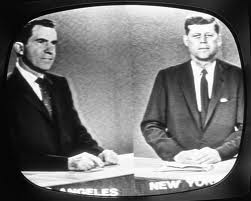
Whether Kennedy’s handlers were much more prophetic about the impact of TV, or whether Kennedy just lucked out, we may never know. What we do know is that Kennedy’s appearance on TV during that debate changed the path of American politics forever. A majority of Americans who listened to the debate solely via radio pronounced Nixon the winner. A majority of the over 70 million who watched the televised debate pronounced Kennedy the easy winner.

Are you beginning to see why this appeals to comms geeks? The suggestion that a newly introduced medium could so profoundly impact the perspectives of so many people in the context of a very high stakes popularity contest was tantalizing. It remains tantalizing today.

Fast forward 51 years to Obama conducting a Townhall meeting streaming on Facebook, and to GOP Presidential candidates using Twitter and Facebook metrics to potentially supplant traditionally collected polling information.

What would happen if you could use Twitter, Facebook or good old Google Analytics to accurately predict the outcome of the 2010 Presidential Election? Some growing social media analytics companies such as Likester are doing just that by measuring the uptick in popularity of pages and social networking presences. In fact, Likester accurately predicted this year’s American Idol winner way back in April.

But how scientific is this data, and what exactly is being measured? As Mashable reports, Likester mostly measures popularity and predicts winners based on the aggregation of “likes” on Facebook in concert with high-profile events. For the GOP debate, “The stand-out frontrunner was Mitt Romney, who ended the night with the greatest number of new Facebook Likes and the greatest overall Likes on his Page.” As we can see, Likester basically began the ticker right when the debate began and distinguished between unique “likes,” or “likes” that occurred after the debate had started, from overall likes. In the end Romney had 19,658 unique or new “likes” during the debate, resulting in 955,748 total “likes,” representing a 2.06% increase in overall “likes” during and directly following the televised debate.

Likester reported, “Michelle Bachmann ranked second in the number of new Likes on her Facebook Page.” In numbers that came out to 9,232 unique or new “likes,” 326,225 total, representing a 2.75% increase.

Care of nation.foxnews.com

Naturally, AdWeek threw their two cents into the discussion, arguing:

“Polling has always been an important element to any electoral bid, but now a new type of impromptu assessment is coming to the fore. Third parties, such as analytics startup Likester, are carving out a space for themselves by processing data that is instantaneously available.”

I’ll give you instantaneously available, but, again, how scientific is this? After all, no one seems to be taking into account what I would call the “hipster correlate.” The hipster correlate is the number of Facebook users who would have “liked” a Romney or Bachmann or Ron Paul page in a stab at some hipster-ish irony, thus proving to those who check their Facebook page or read their status updates their outstanding skills of irony in becoming a fan of a Tea Partier web page, etc. If we’re really doing statistical regressions here, what’s the margin of error here, Likester?

Additionally, how closely can we attach the fidelity of someone who “likes” a Facebook page to a living, breathing politician? On my Facebook page I think I have “liked” mayonnaise, but if there were to be a vote between mayo and ketchup to determine which condiment would become the new official condiment of the U.S., would I necessarily vote mayo? That’s actually kind of a crap analogy, but you get what I mean.

Before we are forced to read more blogs and news articles (like this one!) pronouncing exit polls dead and Facebook and Twitter as the new polling media, I’d like to see a very solid research study conducted as to how closely becoming a fan of a political Facebook page correlates to Americans’ actual voting behavior. In other, more web-based marketing terms, what’s the voting conversion rate for political Facebook pages?

Has anyone seen anything like that?

In other words, please, social scientists and pollsters, show us whether yet another new medium is disrupting the way that Americans individually see and interact with their political candidates, and how that medium has begun to shape the way those political candidates are regarded by an American audience as a whole.


Did anyone read (or care?) about the eG8 Forum that just happened in France? The one where G8 leaders are discussing the need for a set of guidelines for aligning governmental policies towards the Internet in all participating G8 countries.

No? I’m not surprised.

If you do care, check out the Infographic that Mashable published on the event. It’s humorous because of how it pits a net-hostile Nicolas Sarkozy against tech luminaries like Mark Zuckerberg and Eric Schmidt.

Care of mashable.com

I think my favorite tweet from the infographic is from JP Barlow who quotes Sarko as saying, “the internet is the new frontier, a territory to conquer” to which Barlow responds, “and I am in Paris to stop him.”

Jeff Jarvis, a favorite thinker/blogger of mine, tweeted, “at the #eG8 government acts as if it should protect us from the internet. Instead, the internet needs protection from the government.”

That sort of encapsulates why it is hilarious that a bunch of primarily European countries (plus the US and Canada) would think that the world would care about their opinions on how to regulate the internet. I mean, a) Most of the member countries in the G8 are not exactly internet or technological trailblazers, so who really cares what their thoughts are on the internet?; and b) The internet, as platform, and its network of global users (with the exception of China, perhaps) has proven that it will generally laugh in the face of anyone who tries to closely regulate it. After all, ardent internet users are usually light years ahead of the technological curve and the tactics of countries that would attempt to control them.

Which leads me to this: Thank you Sarko for this outstanding opportunity for me to vent some of my now-out-of-date frustration about France’s approach to the internet and web-based technologies.

Having worked briefly (6 months) with a “French web-based startup” while I lived in Paris, I’m going to argue that I have some right to write a bit about what I have observed of France’s relationship with the internet.

Please note, this is not a ranting session about France and its people. I really love France and its people. It is, in fact, because of my love for France and its people, I was seriously pained every day to observe what I did of France’s technologically masochistic tendencies

France is known for a great many wonderful things- things that, as I see it, are mostly rooted in tangibility- art, food, architecture, wine, the countryside, huge airplanes, cheese. France has also been recognized for its achievement of landmark historical intangibles, such as the French Revolution and the Declaration of Rights of Man and of the Citizen. Unfortunately, those both date from the 18th century, and so here we begin to see the problem.

France has lost its ability to embrace and foster the intangible. As a result, in a modern world where elements of intangibility are widely regarded as the inevitable future of many markets and economies, France has fallen woefully behind.

But, if you look closer, there is strong evidence to suggest that France’s masochistic approach to technology and the internet was inevitable. Indeed, a disdain for intangibles is intrinsically French. As a largely hierarchical and bureaucratic culture, France is a country in serious need of more deregulation, decentralization and privatization.

As an example, when I worked at this Paris-based eCommerce firm, part of my responsibility as half of the team of two people who cleaned and organized the entire U.S. catalog of items for purchase (already ludicrous, no?) was to translate the items names and their categorization in the back-end catalog.

The unbelievable truth of this company’s strategy was that all translations and categorizations were completed relative to the original French framework. In the case of the U.S. site there was some added ridiculousness- the categories and terms for items were replicated and translated from the original French, into British English, and my job was then to translate those categories and items names into American English language equivalents.

So, there were whole sections in the food area of the online site dedicated to “French wines,” and “caviars,” and “puddings,”  but I had to go through an arduous process to create American food categories, such as “cookies,” “French fries,” etc. When I asked why we had to base our catalogue off of the French and British ones in the first place, thereby creating so much more work for ourselves than would have been necessary if we had begun from scratch with an American site, I was met with a stony stare. I was later informed that questioning the original French framework for categorization was just not done. An outstanding example of French pride, bureaucracy, hierarchy and lack of global insight all-in-one.

In other words, the same culture that allows for a ban on the display of religious clothing in public places, that mandates one style of handwriting for all, and only one version of its national language also has seemingly little concept of the importance of the globally diverse population of the internet, or from the opposite perspective, localization. Don’t get me wrong, in many ways I admire how the French hold on to their language proudly and refuse to compromise in its usage. But this linguistic pride and a nationally shared sense that their global relevance is slipping inhibits their ability to think globally, to develop a global mindset. France is still so stuck on how to force the world to recognize it as a great power, and to follow its models and its rules for governance, that it has forgotten that in order to be relevant, it must also be a part of the brave, new, global reality that operates within and without its own physical borders.

Unless France can begin to embrace the internet as central to its future, and foster more technological and, specifically, web-based innovation, it risks becoming increasingly irrelevant to the 21st century context. France is badly in need of a Twitter, a Facebook, or a Google of its own to send out as an ambassador and a symbol to the world- but from what I observed during my two years in Paris, it is a long way from achieving that. In the mean time, I guess we will all watch Sarko butt his head against some of the greatest thinkers and innovators of the 21st century, and try hard not to laugh.


Just because twitter is an American company, does it not have to play by other countries’ laws when it becomes embroiled in legal cases involving free speech?

That’s exactly the sort of mess that Twitter finds itself in today in the U.K. where a “British soccer player has been granted a so-called super-injunction, a stringent and controversial British legal measure that prevents media outlets from identifying him, reporting on the story or even from revealing the existence of the court order itself” in order to avoid being identified by name in scandalous tweets.  Unfortunately for the player, the super injunction has been ineffective and “tens of thousands of Internet users have flouted the injunction by revealing his name on Twitter, Facebook and online soccer forums, sites that blur the definition of the press and are virtually impossible to police.”

But I would argue that what is being blurred here is not necessarily the definition of the press, but rather the physical borders of a country where it meets the nebulous nature of the net.

How do we reconcile the physical, geographical and legal boundaries in which we live with the boundless expanses of the internet? I’m sure many people would agree that the democratic (in that it’s arguably free, fair and participatory) nature of Twitter’s platform and mission is inherently American. That Twitter’s ‘Americanness’ is built into its very code. So how do you transplant an American messaging platform such as Twitter’s in other countries and then expect it to be above or fly below the laws of another country?

“Last week…the athlete obtained a court order in British High Court demanding that Twitter reveal the identities of the anonymous users who had posted the messages.” But back in January of this year, as the New York Times reports, “Biz Stone, a Twitter founder, and Alex Macgillivray, its general counsel, wrote, ‘Our position on freedom of expression carries with it a mandate to protect our users’ right to speak freely and preserve their ability to contest having their private information revealed.’”

So what law should be followed in this case? According to the NYTimes, “Because Twitter is based in the United States, it could argue that it abides by the law and that any plaintiff would need to try the case in the United States, legal analysts said. But Twitter is opening a London office, and the rules are more complicated if companies have employees or offices in foreign countries.”

Yet our technologies and our corporations are very much U.S. representatives overseas. Google’s, Microsoft’s, Twitter’s, etc. offices in other parts of the world are nearly tantamount to U.S. embassies abroad.  These companies in large part bear the brunt of representing American ideals and encapsulate American soft power. Even the average Chinese person who may never encounter a flesh-and-blood American will most likely interact with multiple different examples of American cultural goods in his or her lifetime, largely due to the global proliferation of our technologies and media. Which is why, in large part, Twitter and Google have been banned in China. Too democratic for the Chinese government’s liking.

In his chapter (Chapter 1.4) of the Global Information Technology Report (GITR), Cesar Alierta with Telefonica argues that we are in the middle of “the fifth revolution.” The first revolution was the Industrial Revolution, then came Steam Power, then Electricity, then Oil, and now we are in the Information and Communication technology revolution- the fifth. He writes, “Each of these eras has entailed a paradigm shift, more or less abrupt or disruptive, which has led to profound changes in the organization of the economy, starting with individual businesses, and eventually, transforming society as a whole.”

What if we assume that- even if it’s not the original intent- the tacit intent of a technology is to become embedded in someone’s life until it’s nearly impossible to remember living before it. If America’s technologies are little carriers of soft power democratic beliefs and practices, aren’t those beliefs also becoming embedded as well? If so, really, where do we draw the line about the use of a technology in a country other than the one where it was invented?

And though indeed this is an example of a conflict occurring between two very first world countries (the U.S. and the U.K.) This may be one of the greatest barriers to ICT adoption in emerging and developing economies.

In their chapter (Chapter 1.2) of the 2011 Global Information Technology report, Enrique Rueda-Sabater and John Garrity from Cisco Systems, Inc. argue that the “treatment of broadband networks…as basic infrastructure; the recognition that competition is one of the best drivers of technology adoption, and imaginative policies that facilitate access to spectrum and to existing infrastructure that can be shared by networks” are necessary preconditions to accelerated Information and Communication Technologies (ICT). However, the beliefs that underlie those preconditions, 1) that all citizens of a country deserve unlimited access to the internet as a basic human right, and 2) that competition (which can be read as capitalism here) is one of the best drivers of technology adoption, do not seem to necessarily be universal values.

Certainly the belief that unlimited access to the internet is a basic human right is a fast-growing belief among developed economies of the world. As Karim Sabbagh, Roman Friedrich, Bahjat El-Darwiche, and Milind Singh of Booz & Company write in their Chapter (Chapter 1.3) on “Building Communities Around Digital Highways,” “In July 2010…the Finnish government formally declared broadband to be a legal right and vowed to deliver high-speed access (100 megabytes per second) to every household in Finland by 2015. The French assembly declared broadband to be a basic human right in 2009, and Spain is proposing to give the same designation to broadband access starting in 2011.”

But Finland and Spain are both democracies, and France, is a republic with strong democratic traditions. Democracies tend to believe in transparency, accountability and the free dissemination of information, so naturally the adoption of technologies which put the ability to freely disseminate and consume information squarely in the hands of its people jibe with those beliefs. But that is not so in non-democratic societies. I would thus argue that some form of democracy, well-established, should also be considered as a pre-condition for the accelerated adoption of ICT.  And if a country has already heavily adopted and invested in ICT, just as Britain has, that then, as we have seen here, the accelerated deployment of ICT will also bring about accelerated petitioning for expanded democratic rights among its people.


Ooohhh ho ho! This one is good. Really, really good, people.

We interrupt our analysis of the 2011 Global information technology Report to give you news about some gossipy, tech rivalry backstabbing.

What do you get when you take one of the biggest powerhouse PR firms in the world and plug it in between two of the most influential global technology companies? Modern info wars, people. Modern information warfare!

As Dan Lyons wrote in his Daily Beast report on this, for the last week or so word got out that Burson-Marsteller had been retained to pitch an anti-Google PR campaign that urged credible news outlets to investigate claims that Google was invading people’s privacy.

Word got out because Burson “offered to help an influential blogger write a Google-bashing op-ed, which it promised it could place in outlets like The Washington Post, Politico, and The Huffington Post.” The offer, it appears, was turned down by blogger Chris Soghoian who then publicized the emails BM sent him after they refused to reveal their patron.

Next, “USA Today broke a story accusing Burson of spreading a ‘whisper campaign’ about Google ‘on behalf of an unnamed client'” and after that, Facebook, it was revealed, was the crooked, Whispering Wizard behind the curtain.

This is the kind of stuff that makes comms geeks like me drool! PR, search and social networking combined in one story?

So let’s break down the elements that make this so juicy. First, for Facebook to be accusing anyone else of being flippant or irresponsible about user privacy is ridiculous. Plain ridiculous. When your founder and CEO is Mr. “Privacy is Dead,” you cannot take that position. Period.

Second, it’s so interesting to see Facebook getting upset about Google doing what it was invented to do, i.e. cull information from every relevant source on the net and organize it in a meaningful way to those searching for it. For Facebook to think that it would be immune to the reach of the Google information engine’s grasp is delusional. In essence, the crux of Facebook’s whole problem with this situation lies herein: “just as Google built Google News by taking content created by hundreds of newspapers and repackaging it, so now Google aims to build a social-networking business by using that rich user data that Facebook has gathered.”

Third, I love how Lyons cuts through all of that and gets down to the brass tacks: “The clash between Google and Facebook represents one of the biggest battles of the Internet Age. Basically, the companies are vying to see who will grab the lion’s share of online advertising.” Yup.

He continues, “Facebook has 600 million members and gathers information on who those people are, who their friends are, and what they like. That data let Facebook sell targeted advertising. It also makes Facebook a huge rival to Google.” There I actually don’t agree with him, because of what I see as their divergent relative scopes.

Although Facebook has done a remarkable job of positioning itself as a competitor to Google in the eyes of the internet public, it’s just not remotely possible. It is a David and Goliath story, where Goliath wins hands down, and then, laughing about squishing little David, goes outside to have a margarita in the sun.

Facebook’s scope started out much too small to then later tack and take on the search giant. Facebook wanted to provide an exclusive network online where people could share information about themselves with other people. Google began as a creature that wanted to dominate the world and all of its information, and has proven how badly by successfully venturing into myriad other arenas. Google aims to “organize the world’s information,” whereas Facebook’s stated goal is to…wait, what is Facebook’s stated goal? A cursory search came up with this article from the Observer about Facebook’s mission statement, which apparently started as “Facebook helps you connect and share with the people in your life,” and has now, rather tellingly, become “Facebook’s mission is to give people the power to share and make the world more open and connected.” Interesting.

But back to the matter at hand- there’s no doubt that Google has performed so well in other arenas that they are well positioned now to really take on the social angle. And as Lyons points out, they have already begun, “Last month, Google CEO and co-founder Larry Page sent out a memo telling everyone at Google that social networking was a top priority for Google—so much so that 25 percent of every Googler’s bonus this year will be based on how well Google does in social.” That may be the first sound of the bugle in Google’s hunt for Facebook’s market share that should play out over the course of the next few years. But if this was Facebook’s “shot across the bow” in that race, then it has made them look, well, ridiculous.

Fourth, I find it interesting how Facebook took down some of Burson-Marsteller’s credibility with it. In politics, usually when a smear campaign is run, the focus of criticism for having done so falls largely upon the candidate himself or herself- and discussions generally center on their morals or ethics for having chosen to go that route. Occasionally the blame falls on the chief campaign manager for having persuaded them to do so, but generally not. In this case BM seems to have taken a lot of the heat for attempting to carry out orders under a condition of anonymity.

This political angle begs a few questions. Namely, in an era when civic engagement is diminishing by the minute for a largely apathetic American audience, are huge corporations fighting the new political battles for our attention? It’s safe to say that large technology corporations such as Microsoft, Apple, Google and Facebook are much more relevant and identifiable to your average American than would be the 2008 class of Presidential candidates. With this new era of political and business landscapes converging, will the political and business practices of smear tactics converge as well?


Last night at about 8:45 pm PT I found out that Osama Bid Laden had been killed. Here’s how that went down:  My brother picked up his iPhone, glanced through his Twitter feed and announced the news as we were waiting for the opening credits for an action movie we had come to see to close out our Sunday nights.

It being Twitter, I suspended disbelief, but felt reasonably confident that the news was true, given the groundswell of information being tweeted about it. And then I moved on with my evening.

Is there anything wrong with that?

Yes. And, no.

Yes, because it was truly a momentous event. It was, in many ways, the culmination of 10 years of searching and frustration, made and broken political careers, physical demonstrations of strength and power, alarmed admissions of weakness and ignorance, aggression and intolerance, inner turmoil and acceptance, American tragedy and dark, dark American comedy. And all I did was continue to sit in my seat and watch a very sub-par movie.

No, because I knew that the next few days would unfurl themselves before me in a constant stream of information about his whereabouts for the last ten years, where he was killed, how he was killed, Obama’s thoughts on his death, everyone’s thoughts on his death, analyses of how this will affect the Presidential race, pronouncements of how this will affect Obama’s legacy in office, and general societal responses to the news of his death. And I would be there to read, watch, listen to, and ingest it all.

The thing about fast-breaking news these days is that it breaks, and it continues to break like a wave hitting the continental shelf over and over and over. This phenomenon gives modern news consumers time to digest that information from all chosen angles, from all chosen sources.

All of that, and all I’m really taking away from this news is a) I am utterly relieved to see a contingent of contacts within my sphere who are conflicted about unabashedly cheering someone else’s death-even if that person is arguably the most hated man of the 21st century. This contingent includes my brother, a member of the U.S. Army Reserves, who was twice deployed to Iraq.

I continue to believe that the greatest American patriots in the world are those who continue to question, and- where fitting- condemn, the loss of life as a necessary price of freedom and security, and who query our government about whether the loss of life abroad is a necessary precondition for maintaining American democracy.

In related news, an obituary for Osama Bin Laden in the NYTimes? A poignant statement in the city that lost the most at his hands.


The fallacy that social media platforms such as Facebook provide “two-way communication,” or a “virtual dialogue” is getting a day in the sun today, following President Obama’s “Town Hall at Facebook headquarters yesterday. While on the surface, media enthusiasts and modern-day communications professionals choose to see Facebook as the future of interactive social media due to live streaming capabilities, instant messaging, Q&A mechanisms, and the ability to cull an audience of thousands, yesterday’s Town Hall event proved that nothing beats a physically present audience.

As the SFGate (SF Chronicle) article declared, “Despite the promise that President Obama’s first Facebook town hall would open a new level of two-way communication with his constituents, social-networking technology didn’t add much to the conversation.”

In all, the President answered eight questions, a few of which were asked by the physically present audience of Facebook employees, and ignored hundreds which were posted by the thousands of virtual attendees. As the SFGate article quotes, “Cynthia Spurling posted: ‘What a joke Facebook! So glad you had this town hall for your employees. The Ask Question button is a joke!’”

As a President of the people, and as a politician campaigning for re-election, why would he do such a thing?

Well, how much time do you have? How about:

A)     A politician is always trained to play to the flesh and blood right in front of him or her, because he can see their eyes, their expressions, and he or she is trained to digest that physical information, as an orator, to sway an audience one way or another. But hell, the normal human reaction is to play to the live audience right in front of you, so that’s not saying much.

B)      The physical audience was a group of employees of Facebook, a cutting edge technology company that employs young, top tier people from all over the country, meaning most of them are equipped with at least a bachelor’s degree, if not a master’s. And historically, studies have suggested that a higher level of attained education generally correlates to a more liberal standpoint among Americans.

C)      Facebook HQ is located in California, a very liberal state.  Thus the President is keenly aware that the average person in the room will be more aligned with his own political standpoints and the standpoints of his party. Knowing that, and knowing he can field their softball questions, why would he cater to the wildcard attendees from other states?

Saying all this, you probably won’t believe it, but I should disclose that I am a big Obama fan. I mean, a BIG OBAMA FAN. But this is just common sense. What I find interesting about it from the communication point of view is not the choices that were made by his team to keep him on the “safe” side of rhetoric, but how surprised people seem to be that he basically ignored the online audience.

Yes, we have become a very virtualized population of individuals, often more comfortable with interacting with screens and mobile devices when given the choice between that and a real person. But the actual act of speaking publicly has not changed much. A skilled orator thrives off of the energy he or she receives back from an audience, and the computer, iPad, iPhone, or Android screens don’t offer any love back.

As I’m wrapping this up, I need to mention what a theater professor of mine once said. This has stayed with me every day of my life. He told us, “don’t ever agree to appear on stage with babies, small children or animals. They will upstage you ever time. The difference is their authenticity of emotion, of movement, of reaction. The second you step on stage with them, you have already lost the audience’s attention to their absolutely authentic behavior, which no actor can match.”

How does this correlate to the fallacy of interactivity, as proven by yesterday’s Facebook Town Hall? The same rule, it would seem, applies to “don’t ever agree to attend a webcast or live streaming event if you know there will be people in the room, physically, with the performer or speaker.” As the virtual audience, you will always lose. The physical audience will upstage you every time.


In March of 2011, Pelago, the company known for having produced Whrrl, wrote a mini essay detailing their ideas about a concept they labeled “anti-search.” Anti-search, they claimed, was a movement in search of “serendipitous world discovery,” writing: “Search engines are good at addressing those “high intent” situations, like “where’s the closest Starbucks?” or “what kind of food does this place serve?” or “how are the reviews for this restaurant?”  You know what you’re looking for and it’s easy to express your intent as a query” and continues, “Serendipity is “zero intent” discovery, i.e. when you aren’t actually looking for something, but a great idea finds you.   Between these two extremes are discovery missions of varying degrees of intent, e.g. “I’m hungry” or “I’m bored.”

Which they represented by this interesting little graphic:

For me, this brings up the question, has the deliberate searching and querying of our surroundings via technology– whether those surroundings are natural or unnatural—really precluded the opportunities for actually, well, discovering places and things? Is there a chance that with the proliferation of location aware technologies, and geographic social mobility coupled with mobile internet access, we are no longer actually capable of physically seeing and interacting with what is actually around us? Are we completely incapable of tripping down a little ivy-laden alley and discovering a mural, or a coffee shop, or a funky shoe store without the aid of a mobile device or online coupon website?

According to Pelago, anti-search is comprised of three elements:

  1. “The right data in order to “know” a user.  I.e. user actions like check-ins, the social graph, interactions among users (which I’ll talk about in a second), etc.
  2. The right algorithms.  We need to take all this data and turn it into personalized recommendations.
  3. The right social ecosystem.  This is decidedly the hardest part.  The necessary content and data is locked up in people’s heads and hearts – we need to make it motivating and easy to get that content out, to get people taking the necessary actions to create the data to feed the algorithms that ultimately allow us to provide an amazing discovery experience.” (http://www.pelago.com/blog/community/2011/03/its-time-for-real-world-anti-search/)

But I would argue that the act of discovery does not rule out the possibility that the discoverer will stumble upon something they don’t like, something they wouldn’t have chosen. I would also argue that to prevent each of us from doing so is robbery, plain and simple, of the experience being challenged in our sense of taste. How are we supposed to define what we don’t like about something if we’re never faced with the distasteful something in the first place?

Besides, the word serendipity – in part- refers to an unintended experience. How can you possibly achieve that if your intention is to plug a social recommendation engine full of data to steer you towards intended unintended situations or experiences?

Which is why, with Groupon’s reported acquisition of Pelago, the whole ridiculous ethos of these sites and recommendation engines (which are, at their heart, merely designed to sell you things) has come full circle in a doomed cycle of self-mockery.

This acquisition clearly runs counter to Whrrl’s stated “anti-search” goal of “serendipitous world discovery.”

Case in point: how many among us have purchased at least one Groupon at this point (i.e. are unique Groupon users)? There aren’t any real numbers on that at this point, but it’s safe to say that number is in the millions, given that the number of Groupons bought at the time that this was published was in the 40 million range. Yet how many of us have subsequently struggled to find the time or the energy to use said coupon, or let the coupons pile up until one or two have expired without being used? I’d wager that number is in the high hundreds of thousands, if not also in the millions.

So someone tell me how that’s not intent or a deliberate attempt to make the time to go somewhere and use something that was purchased with that specific intent in mind. It’s not serendipity, it’s a scheduled appointment to go spend money at a pre-determined location.

At the risk of sounding like a complete luddite, the next time someone wants to indulge in a little “serendipitous world discovery,” I would honestly recommend that they go for a walk in their neighborhood- no headphones, no phone- just them and the buildings, parks, animals, and people around them.


October 19, 2010- http://www.gather.com/viewArticle.action?articleId=281474978616790

Remember that scene in the film Back to the Future where Marty McFly realizes that in the photo he carries of his family, he is fading from existence because of the events of the past not transpiring as they should? As a result, he faces the possibility that the shape of his family will change forever? Well, as it turns out, that’s not necessarily impossible.

At least, not according to one of the lead designers and developers at Mozilla, Aza Raskin, Creative Lead for Firefox. During his keynote speech at the University of Michigan School of Information Raskin claimed “the human brain’s predictable fallibility leaves us susceptible to the creation of false memories by brand marketers through retroactive product placement into our photos posted on Facebook and other social networks,” and his assertions are getting a lot of coverage. Raskin, only 27 years old, is one of Mozilla’s most talented innovators, and thus his arguments are by no means falling upon deaf ears. In essence, he’s predicting that social networks will modify our uploaded photos to include product placements and therefore modify our memories.

Specifically addressing the advertising and marketing potential involved in this ploy, Raskin claimed, “We will have memories of things we never did with brands we never did. Our past actions are the best predictor of our future decisions, so now all of a sudden, our future decisions are in the hands of people who want to make money off of us.”

During the talk, to bolster his cautionary predictions Raskin touched upon neurological research into memories and cited the Hollywood blockbuster Inception, which addressed the future potential to tap into and manipulate dreams and memories. This concept of subliminal advertising was also recently addressed in a viral video created by UK illusionist Derren Brown, “Subliminal Advertising,” where the practice of advertising is turned on its head when two high-end advertisers are manipulated into spontaneously generating a pre-determined pitch for a product.

Raskin’s keynote came at an unfortunate time for Facebook, who this week is once again suffering intense scrutiny for their privacy practices. As the New York Times argued, “When you sign up for Facebook, you enter into a bargain…At the same time, you agree that Facebook can use that data to decide what ads to show you.” Yet it was Mark Zuckerberg, the much publicized chief of Facebook, who this week apologized to his users for overly complicated site settings and acknowledged that some app developers on its site shared identifying information about users with advertisers and Web tracking companies.

However, as the New York Times reports, “Facebook has grown so rapidly, in both users and in technical complexity, that it finds it increasingly difficult to control everything that happens on its site.” If you consider that Facebook still claims just over 1,700 employees it seems unlikely that in the next few years the social media Goliath will grow rapidly enough to expand their advertising model to modify users’ uploaded content such as photos and videos. Nor is it entirely clear why they would want to do such a thing, given how infrequently users tend to re-visit their photos even weeks after they have posted them.

On the other side of the U.S., U.C Berkeley professor and privacy expert Deirdre Mulligan had this to say about Facebook: “This is one more straw on the camel’s back that suggests that Facebook needs to think holistically not just about its privacy policies, but also about baking privacy into their technical design.”

In the meantime, perhaps we should all pop some ginkgo biloba and back up the current versions of our photos- just incase.


October 19, 2010- http://www.gather.com/viewArticle.action?articleId=281474978616650

This last week a number of well-respected analysts and research centers released reports discussing the pervasive dominance of “post-PC devices.” Specifically the discussion is revolving around mobile phones, smartphones, tablets and e-readers. The Pew Research Center released its report on “gadget ownership” which demonstrated the overall dominance of cell phones in the U.S. Technology market. Pew surveyed 3,001 American adults and decided upon the “key appliances of the Information Age.” Those which came out on top were cellphones, PCs, e-readers, and Mp3 players.

Gartner and Forrester also threw their hat into the “buzz” ring. Gartner released its own report Friday which proclaims tablets the new cellphone. In the study Gartner reports that tablet sales have reached 19.5 million units this year and estimated that tablet sals would increase to 150 million units by 2013. In fact, Carolina Milanesi, a research vice president at Gartner, claims mini notebook computers “will suffer a “strong cannibalization” as the price of media tablets” drops nearer to the $300 mark.

In their report, Forrester chose to address head-on the new era security concerns that companies and consumers will experience as society continues to adopt these post-PC devices. In its report, Forrester discusses the additional security companies will have to implement for mobile devices commonly now used both at work and at play.

Yet as these respected analysts hail the new post-PC era, tablets and e-readers are still exploring the new hazards of a post-PC world. Just this week the New York Times posted an article which discusses the temperature control problems for Apple’s iPads and compares it to Amazon’s Kindle. Or, as the New York Times wrote it, “It seems that some iPads do not like direct sunlight, saunas or long walks on the beach.” And with the iPhone 4G’s antenna challenges earlier this summer, it’s clear that we’re nowhere near having worked out all of the kinks even as the mobile device market continues to innovate and we adopt their emerging products.


October 08, 2010- http://www.gather.com/viewArticle.action?articleId=281474978584428

MTV and Foursquare are being recognized by Mashable as one of the most creative social media campaigns of 2010 for their efforts on the first-ever cause-related badge: GYT. In September of this year, FourSquare and MTV partnered to launch the GYT campaign, which stands for “Get Yourself Tested.”

The campaign seeks to promote STD testing among young adults by offering them the GYT badge of courage for checking in at an STD clinic. As reported on Mashable, “The Foursquare partnership encourages people to follow MTV on Foursquare, check in after getting tested and shout “GYT” to their followers. After doing so, users will earn the GYT badge, and thereby make it known that they’re taking control of their sex lives. Those who score the badge will also be entered to win a trip for two to New York City, as well as backstage passes to MTV’s 10 on Top.”

Despite the offer of a trip and backstage passes, one would think that the still-widespread cultural stigmatization associated with STD testing would keep users away from this campaign. Yet the campaign has achieved a solid amount of success, with more than 3,000 GYT badges awarded since the campaign was launched a few weeks ago.

The campaign is most definitely a vital first, and a great example of how geo-location technologies may help non-profit organizations all over the world to mobilize and support positive causes. It remains to be seen how many non-profits are able to capitalize on the success of this particular campaign, and use location-aware technologies to aid in the struggle to promote their own causes.