Archive for the ‘Politics’ Category


Just because twitter is an American company, does it not have to play by other countries’ laws when it becomes embroiled in legal cases involving free speech?

That’s exactly the sort of mess that Twitter finds itself in today in the U.K. where a “British soccer player has been granted a so-called super-injunction, a stringent and controversial British legal measure that prevents media outlets from identifying him, reporting on the story or even from revealing the existence of the court order itself” in order to avoid being identified by name in scandalous tweets.  Unfortunately for the player, the super injunction has been ineffective and “tens of thousands of Internet users have flouted the injunction by revealing his name on Twitter, Facebook and online soccer forums, sites that blur the definition of the press and are virtually impossible to police.”

But I would argue that what is being blurred here is not necessarily the definition of the press, but rather the physical borders of a country where it meets the nebulous nature of the net.

How do we reconcile the physical, geographical and legal boundaries in which we live with the boundless expanses of the internet? I’m sure many people would agree that the democratic (in that it’s arguably free, fair and participatory) nature of Twitter’s platform and mission is inherently American. That Twitter’s ‘Americanness’ is built into its very code. So how do you transplant an American messaging platform such as Twitter’s in other countries and then expect it to be above or fly below the laws of another country?

“Last week…the athlete obtained a court order in British High Court demanding that Twitter reveal the identities of the anonymous users who had posted the messages.” But back in January of this year, as the New York Times reports, “Biz Stone, a Twitter founder, and Alex Macgillivray, its general counsel, wrote, ‘Our position on freedom of expression carries with it a mandate to protect our users’ right to speak freely and preserve their ability to contest having their private information revealed.’”

So what law should be followed in this case? According to the NYTimes, “Because Twitter is based in the United States, it could argue that it abides by the law and that any plaintiff would need to try the case in the United States, legal analysts said. But Twitter is opening a London office, and the rules are more complicated if companies have employees or offices in foreign countries.”

Yet our technologies and our corporations are very much U.S. representatives overseas. Google’s, Microsoft’s, Twitter’s, etc. offices in other parts of the world are nearly tantamount to U.S. embassies abroad.  These companies in large part bear the brunt of representing American ideals and encapsulate American soft power. Even the average Chinese person who may never encounter a flesh-and-blood American will most likely interact with multiple different examples of American cultural goods in his or her lifetime, largely due to the global proliferation of our technologies and media. Which is why, in large part, Twitter and Google have been banned in China. Too democratic for the Chinese government’s liking.

In his chapter (Chapter 1.4) of the Global Information Technology Report (GITR), Cesar Alierta with Telefonica argues that we are in the middle of “the fifth revolution.” The first revolution was the Industrial Revolution, then came Steam Power, then Electricity, then Oil, and now we are in the Information and Communication technology revolution- the fifth. He writes, “Each of these eras has entailed a paradigm shift, more or less abrupt or disruptive, which has led to profound changes in the organization of the economy, starting with individual businesses, and eventually, transforming society as a whole.”

What if we assume that- even if it’s not the original intent- the tacit intent of a technology is to become embedded in someone’s life until it’s nearly impossible to remember living before it. If America’s technologies are little carriers of soft power democratic beliefs and practices, aren’t those beliefs also becoming embedded as well? If so, really, where do we draw the line about the use of a technology in a country other than the one where it was invented?

And though indeed this is an example of a conflict occurring between two very first world countries (the U.S. and the U.K.) This may be one of the greatest barriers to ICT adoption in emerging and developing economies.

In their chapter (Chapter 1.2) of the 2011 Global Information Technology report, Enrique Rueda-Sabater and John Garrity from Cisco Systems, Inc. argue that the “treatment of broadband networks…as basic infrastructure; the recognition that competition is one of the best drivers of technology adoption, and imaginative policies that facilitate access to spectrum and to existing infrastructure that can be shared by networks” are necessary preconditions to accelerated Information and Communication Technologies (ICT). However, the beliefs that underlie those preconditions, 1) that all citizens of a country deserve unlimited access to the internet as a basic human right, and 2) that competition (which can be read as capitalism here) is one of the best drivers of technology adoption, do not seem to necessarily be universal values.

Certainly the belief that unlimited access to the internet is a basic human right is a fast-growing belief among developed economies of the world. As Karim Sabbagh, Roman Friedrich, Bahjat El-Darwiche, and Milind Singh of Booz & Company write in their Chapter (Chapter 1.3) on “Building Communities Around Digital Highways,” “In July 2010…the Finnish government formally declared broadband to be a legal right and vowed to deliver high-speed access (100 megabytes per second) to every household in Finland by 2015. The French assembly declared broadband to be a basic human right in 2009, and Spain is proposing to give the same designation to broadband access starting in 2011.”

But Finland and Spain are both democracies, and France, is a republic with strong democratic traditions. Democracies tend to believe in transparency, accountability and the free dissemination of information, so naturally the adoption of technologies which put the ability to freely disseminate and consume information squarely in the hands of its people jibe with those beliefs. But that is not so in non-democratic societies. I would thus argue that some form of democracy, well-established, should also be considered as a pre-condition for the accelerated adoption of ICT.  And if a country has already heavily adopted and invested in ICT, just as Britain has, that then, as we have seen here, the accelerated deployment of ICT will also bring about accelerated petitioning for expanded democratic rights among its people.


Ooohhh ho ho! This one is good. Really, really good, people.

We interrupt our analysis of the 2011 Global information technology Report to give you news about some gossipy, tech rivalry backstabbing.

What do you get when you take one of the biggest powerhouse PR firms in the world and plug it in between two of the most influential global technology companies? Modern info wars, people. Modern information warfare!

As Dan Lyons wrote in his Daily Beast report on this, for the last week or so word got out that Burson-Marsteller had been retained to pitch an anti-Google PR campaign that urged credible news outlets to investigate claims that Google was invading people’s privacy.

Word got out because Burson “offered to help an influential blogger write a Google-bashing op-ed, which it promised it could place in outlets like The Washington Post, Politico, and The Huffington Post.” The offer, it appears, was turned down by blogger Chris Soghoian who then publicized the emails BM sent him after they refused to reveal their patron.

Next, “USA Today broke a story accusing Burson of spreading a ‘whisper campaign’ about Google ‘on behalf of an unnamed client'” and after that, Facebook, it was revealed, was the crooked, Whispering Wizard behind the curtain.

This is the kind of stuff that makes comms geeks like me drool! PR, search and social networking combined in one story?

So let’s break down the elements that make this so juicy. First, for Facebook to be accusing anyone else of being flippant or irresponsible about user privacy is ridiculous. Plain ridiculous. When your founder and CEO is Mr. “Privacy is Dead,” you cannot take that position. Period.

Second, it’s so interesting to see Facebook getting upset about Google doing what it was invented to do, i.e. cull information from every relevant source on the net and organize it in a meaningful way to those searching for it. For Facebook to think that it would be immune to the reach of the Google information engine’s grasp is delusional. In essence, the crux of Facebook’s whole problem with this situation lies herein: “just as Google built Google News by taking content created by hundreds of newspapers and repackaging it, so now Google aims to build a social-networking business by using that rich user data that Facebook has gathered.”

Third, I love how Lyons cuts through all of that and gets down to the brass tacks: “The clash between Google and Facebook represents one of the biggest battles of the Internet Age. Basically, the companies are vying to see who will grab the lion’s share of online advertising.” Yup.

He continues, “Facebook has 600 million members and gathers information on who those people are, who their friends are, and what they like. That data let Facebook sell targeted advertising. It also makes Facebook a huge rival to Google.” There I actually don’t agree with him, because of what I see as their divergent relative scopes.

Although Facebook has done a remarkable job of positioning itself as a competitor to Google in the eyes of the internet public, it’s just not remotely possible. It is a David and Goliath story, where Goliath wins hands down, and then, laughing about squishing little David, goes outside to have a margarita in the sun.

Facebook’s scope started out much too small to then later tack and take on the search giant. Facebook wanted to provide an exclusive network online where people could share information about themselves with other people. Google began as a creature that wanted to dominate the world and all of its information, and has proven how badly by successfully venturing into myriad other arenas. Google aims to “organize the world’s information,” whereas Facebook’s stated goal is to…wait, what is Facebook’s stated goal? A cursory search came up with this article from the Observer about Facebook’s mission statement, which apparently started as “Facebook helps you connect and share with the people in your life,” and has now, rather tellingly, become “Facebook’s mission is to give people the power to share and make the world more open and connected.” Interesting.

But back to the matter at hand- there’s no doubt that Google has performed so well in other arenas that they are well positioned now to really take on the social angle. And as Lyons points out, they have already begun, “Last month, Google CEO and co-founder Larry Page sent out a memo telling everyone at Google that social networking was a top priority for Google—so much so that 25 percent of every Googler’s bonus this year will be based on how well Google does in social.” That may be the first sound of the bugle in Google’s hunt for Facebook’s market share that should play out over the course of the next few years. But if this was Facebook’s “shot across the bow” in that race, then it has made them look, well, ridiculous.

Fourth, I find it interesting how Facebook took down some of Burson-Marsteller’s credibility with it. In politics, usually when a smear campaign is run, the focus of criticism for having done so falls largely upon the candidate himself or herself- and discussions generally center on their morals or ethics for having chosen to go that route. Occasionally the blame falls on the chief campaign manager for having persuaded them to do so, but generally not. In this case BM seems to have taken a lot of the heat for attempting to carry out orders under a condition of anonymity.

This political angle begs a few questions. Namely, in an era when civic engagement is diminishing by the minute for a largely apathetic American audience, are huge corporations fighting the new political battles for our attention? It’s safe to say that large technology corporations such as Microsoft, Apple, Google and Facebook are much more relevant and identifiable to your average American than would be the 2008 class of Presidential candidates. With this new era of political and business landscapes converging, will the political and business practices of smear tactics converge as well?


The White House finally came forward last week with the decision not to circulate the graphic images that confirmed Osama Bin Laden’s death, and I immediately I believe I heard people around the U.S. (and the world, perhaps?) breathe a mostly collective sigh of relief. Or was that just me?

It is a favorite pronouncement that we are now an image-driven culture, focused chiefly on video, photos, and graphics to learn, retain and discuss the world around us. This pronouncement is made, particularly, in the context of discussions about the RSS-ification of news and information, where all the news that’s fit to print is expected to fit into 140 characters.

See, as the thinking goes, our brains are attempting to consume so much more information than ever before, so the introduction of new forms of media and imagery (read: not text) will help our brains to better retain and render more realistic those discrete and fast-coming pieces of information.

Whatever the strategy of getting information to us, as consumers of information, it is still worth fighting for the chance to use our own discretion when it comes to how we, as humans, want to digest our information. Often we seem to have no choice- the newspapers, site managers, TV and movie producers and editors do that for us. But when we are presented with the choice, many of us would still choose not to see graphic images of death and violence.

[I can already hear the devil on my shoulder wanting to advocate for his side of the story, so as an aside, I will say that I do believe there is power in images. And I believe that things can be rendered more real in our everyday lives by seeing them, even if only through a photographer’s lens. That is often a good thing, particularly for the politically sheltered and/or apathetic masses. But I also believe that things can be too real, and hinder a person’s ability to move on with their life. Or images can be so real, but so simultaneously staggeringly outside the context of someone’s own experience that they  are unreasonably and ineffectively disturbing. I believe the release of images of OBL’s death would have such an effect for many Americans.]

Which is why, I believe, so many Americans have keyed in on the photo taken by the White House photographer and posted on their Flickr feed, of Obama’s staff watching the live feed of the raid in Pakistan.

This photo has become the focal and symbolic  photo of the moment that OBL was killed, and has stirred so many different reactions. For me the photo is staggering on a number of levels:

1)      President Obama is not front and center.

2)      The expression of Secretary of State Clinton’s face (whether she likes it or not)

3)      The fact that we are experiencing the ultimate surveillance moment- through the eyes of someone who was watching the scene through a camera lens, we are watching those who are watching live footage of what was happening.

4)      It is perfect voyeurism, but it is also intensely primal. We are observing the reactions of other human beings to an event we know we must also react to. In their reactions we search for our own feelings about the event, and we take cues.

Incredibly, in their recent Opinionator entry, Gail Collins and David Brooks  brought up pretty much everything that I was thinking when I first saw this photo, but it’s something I think everyone should take a look at, because there is so much to discuss within the limits of this image.

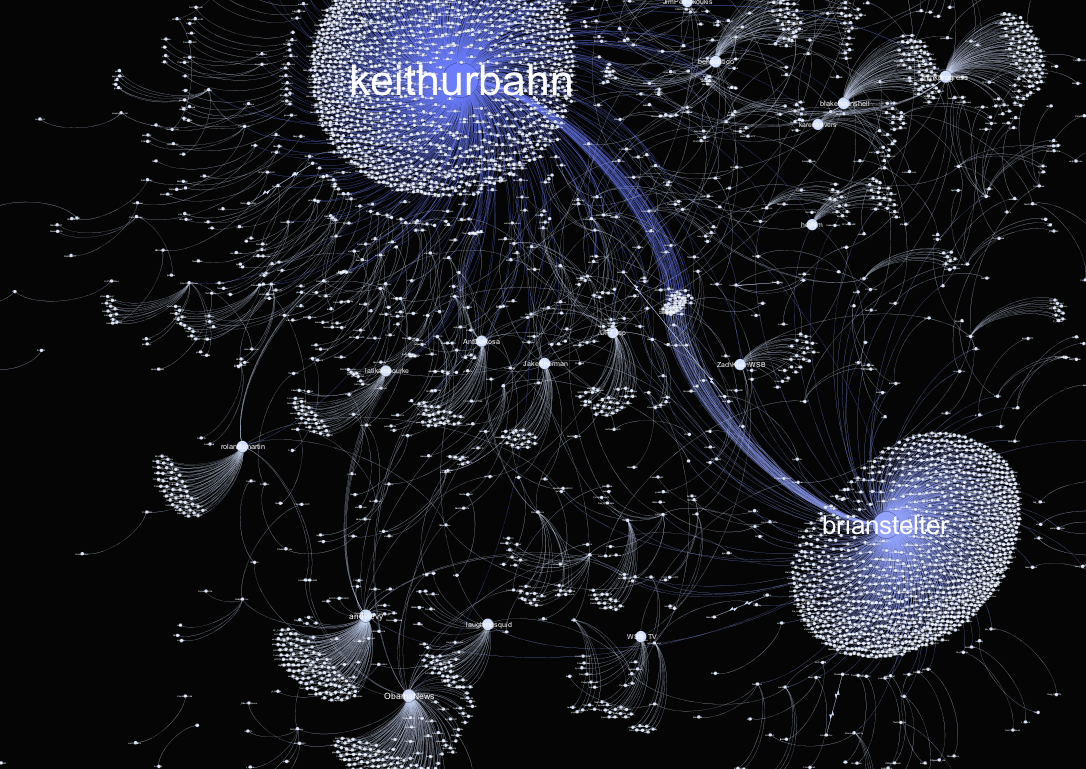
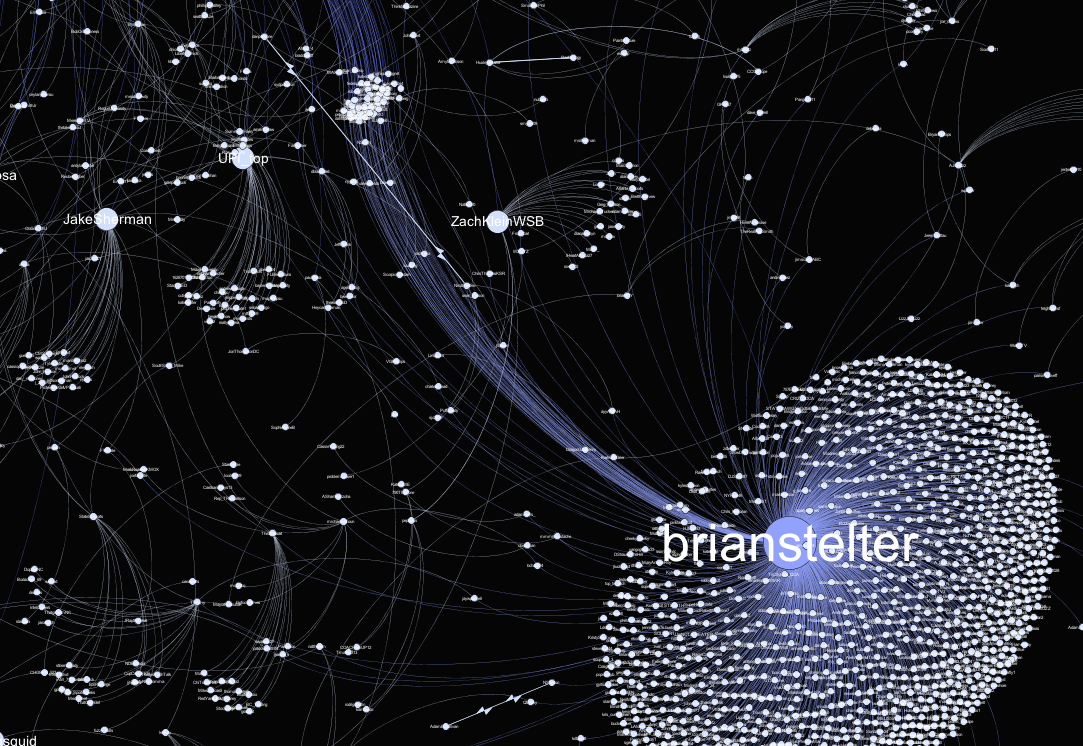
On a similar note, and related to my earlier post about the news of Bin Laden’s death and the role of Twitter in breaking that news, here are some outstanding digital images of the flow of information across the Twitter-verse in the hours preceding and following the White House announcement, care of the SocialFlow blog.

For those of you who are unfamiliar with the company, SocialFlow is a social media optimization platform that is used …to increase engagement (clicks, re-tweets, re-posts and mentions) on Twitter. Our technology determines the optimal time to release the right Tweet based on when your audience is most receptive.”


Last night at about 8:45 pm PT I found out that Osama Bid Laden had been killed. Here’s how that went down:  My brother picked up his iPhone, glanced through his Twitter feed and announced the news as we were waiting for the opening credits for an action movie we had come to see to close out our Sunday nights.

It being Twitter, I suspended disbelief, but felt reasonably confident that the news was true, given the groundswell of information being tweeted about it. And then I moved on with my evening.

Is there anything wrong with that?

Yes. And, no.

Yes, because it was truly a momentous event. It was, in many ways, the culmination of 10 years of searching and frustration, made and broken political careers, physical demonstrations of strength and power, alarmed admissions of weakness and ignorance, aggression and intolerance, inner turmoil and acceptance, American tragedy and dark, dark American comedy. And all I did was continue to sit in my seat and watch a very sub-par movie.

No, because I knew that the next few days would unfurl themselves before me in a constant stream of information about his whereabouts for the last ten years, where he was killed, how he was killed, Obama’s thoughts on his death, everyone’s thoughts on his death, analyses of how this will affect the Presidential race, pronouncements of how this will affect Obama’s legacy in office, and general societal responses to the news of his death. And I would be there to read, watch, listen to, and ingest it all.

The thing about fast-breaking news these days is that it breaks, and it continues to break like a wave hitting the continental shelf over and over and over. This phenomenon gives modern news consumers time to digest that information from all chosen angles, from all chosen sources.

All of that, and all I’m really taking away from this news is a) I am utterly relieved to see a contingent of contacts within my sphere who are conflicted about unabashedly cheering someone else’s death-even if that person is arguably the most hated man of the 21st century. This contingent includes my brother, a member of the U.S. Army Reserves, who was twice deployed to Iraq.

I continue to believe that the greatest American patriots in the world are those who continue to question, and- where fitting- condemn, the loss of life as a necessary price of freedom and security, and who query our government about whether the loss of life abroad is a necessary precondition for maintaining American democracy.

In related news, an obituary for Osama Bin Laden in the NYTimes? A poignant statement in the city that lost the most at his hands.


September 22, 2010 – http://www.gather.com/viewArticle.action?articleId=281474978538594

Sneaking off to smoke cigarettes. Experimenting with alcohol. Sexual experimentation. These are all Hollywood hallmarks and symbols of adolescent youth in the United States. Americans think of the teenage years as the time to get out into the world, try new (and perhaps forbidden) things, and become an adult in the process. But what if in the process, the adolescent become a felon?

Every once in a while a high profile case involving teens and the internet hits the web, and parents start to squirm. Generally, however, these cases highlight how the Net may be perilous to the teen, not how the teen may be perilous to the Net. While in some situations those warnings are legitimate, it may be time for parents to begin to consider another way in which their child’s internet use may be perilous to their future: hacking.

Today’s teens are more tech savvy than any other generation, and the generation that follows them will be all the more savvy. According to a February 2010 study conducted by the Pew Research Center, “Internet use is near ubiquitous among teens and young adults. In the last decade, the young adult internet population has remained the most likely to go online. Over the past 10 years, teens and young adults have been consistently the two groups most likely to go online, even as the internet population has grown and even with documented larger increases in certain age cohorts (e.g. adults 65 and older).”

Thus it is no longer sufficient to think of every teen as wide-eyed and naive about the varied functions and uses for the Net. Many teens are way ahead of the rest of us, hacking and writing code, doing their own programming and creating the next generation’s tools. However, the same teen urges that drive them to experiment with drugs and sex– those strong hits of hormones and a sense of invincibility– also today lead them to commit crimes on the web.

Just this week a 17 year-old Australian teen caused a “massive hacker attack on Twitter which sent users to Japanese porn sites and took out the White House press secretary’s feed.” The teenager, Pearce Delphin, simply revealed a Twitter code security flaw and publicized it. The flaw was then exploited by hackers who subsequently wreaked havoc on Twitter’s user base of more than 100 million for nearly five hours. When asked why he would do such a thing, Delphin reportedly replied, “I did it merely to see if it could be done … that JavaScript really could be executed within a tweet…I had no idea it was going to take off how it did. I just hadn’t even considered it.””

But the story gets better, before the Associated Press could actually hypothesize what the danger of this hack might have been, 17-year old Delphin came through with it first, “Delphin said it could have been used to ‘maliciously steal user account details.’” He told the reporters, “The problem was being able to write the code that can steal usernames and passwords while still remaining under Twitter’s 140 character tweet limit.”

Likewise, in 2008 another 17-year old from Pennsylvania admitted to crashing Sony’s PlayStation site after being banned for cheating in a game called SOCOM U.S. Navy Seals. By intentionally infecting the Sony site with a virus, the teenage honors student was able to crash the site for a duration of 11 days in November 2008. In that case the kid got lucky, rather than pursue the case as a grand jury investigation, the authorities decided to let the teen’s local juvenile court handle the charges. In the end, the 11th grade student was judged delinquent and charged with unlawful use of a computer, criminal use of a computer, computer trespassing and the distribution of a computer virus.

Somewhat humorously, Net security sites like Symantec and McAfee have pages dedicated to teen use and abuse of the Net. Symantec’s is titled “The Typical Trickery of Teen Hackers,” and addresses questions such as “I discovered that my teenager had figured out my computer password and logged in, resetting the parental controls we had installed. How did this happen?.” In their recent 2010 study McAfee reports that, “85 percent of teens go online somewhere other than at home and under the supervision of their parents, nearly a third (32 percent) of teens say they don’t tell their parents what they do while they are online, and 28 percent engage with strangers online. The survey results should serve as a wake-up call for many parents.”

While teenage tomfoolery and trickery is generally regarded as humorous (thanks Hollywood) and as a coming-of-age tendency, the trouble begins when a teen’s future is jeopardized because he or she has not developed a sense for the moral and ethical implications of their actions on the web. Because hacking is not as tangible as, say, stealing a T-shirt at the mall, it is harder for teens to grasp how a few key strokes can be considered criminal. Yet it is up to today’s and tomorrow’s parents to put in the extra effort to educate teens about how their activities online may jeopardize their extremely valuable future.


August 30, 2010- http://www.gather.com/viewArticle.action?articleId=281474978482524

At the beginning of this year Mark Zuckerberg famously announced that privacy was dead, stirring the pot and increasing concerns among the majority of internet users that their identities and personal information were being appropriated for capital gain.

Arguably, 2010 has been the year of “location aware technology,” whether the location is two dimensional or three dimensional. These days your computer knows where you’ve been online, where you’re going, and why you buy things there, and your phone can tell any satellite where you physically are on the globe and what advertising you’re passing at that very moment. Clearly, marketers are doing their best to collect as much of that information as possible and to use it.

One of the main issues in the ongoing debate about whether location aware technology and geotagging are net-positive or net-negative developments (or somewhere in between) centers on the concession that advertising and marketing are not going away any time soon. Advertising is an institutionalized facet of American life, especially in major urban centers. That being said, marketers like to argue that with more information they can better speak to a consumer’s interests and needs, as opposed to leading a consumer to buy something he or she doesn’t need.

Leaving that argument for a minute, the real concern here is over privacy, and educating the masses on how to protect their own privacy. A recent article in the New York Times cautioned readers against geotagging photos at their homes, and cited the example of Adam Savage, one half of the “MythBusters” team who had geotagged a Twitter photo of his car in front of his personal residence in the Bay Area. The Times pointed out that by doing Adam Savage had just informed all of his Twitter followers of his personal address, the make and model of his car, and that he was leaving for work at that very moment, “geotags… are embedded in photos and videos taken with GPS-equipped smartphones and digital cameras. Because the location data is not visible to the casual viewer, the concern is that many people may not realize it is there; and they could be compromising their privacy, if not their safety, when they post geotagged media online.”

Now with Facebook Places, a new feature which allows its users to tag their locations in their status updates, and the increasing use of Twitter and FourSquare, organizations such as the ACLU are concerned that the spread of technology is one again outpacing usage education and awareness of the risks of information abuse, “The organization highlighted the element of the new service that allows users to “tag” an accompanying friend and post his or her location to Facebook – even if the friend does not have an iPhone, which is currently the only platform on which the application is available.”

The other side of this coin involves how browsers and advertisers track our movements online. After all, this is a huge market that Facebook plans to tap, 50 percent of Facebook’s over 400 million users log in to the site at least once a day, and more than a quarter of that overall number access the service from mobile devices. However, despite all of the hype, new research shows that most users still decline to announce their location publicly.

According to a recent Forrester Research report, “Just 4 percent of Americans have tried location-based services, and 1 percent use them weekly…Eighty percent of those who have tried them are men, and 70 percent are between 19 and 35.”

Returning to the modern marketer’s argument that the more information they can gather on a person’s interests, habits and locations, the more applicable an ad will be for a consumer, there is strong evidence to support this. Personalized ad retargeting, where ads for specific products that consumers have perused online follow them around while they continue to browse the web, are becoming more pervasive. And marketers are big believers, “‘The overwhelming response has been positive,’ said Aaron Magness, senior director for brand marketing and business development at Zappos, a unit of Amazon.com.”

Still, consumer sentiment about being monitored, whether online or off, reflects overall concern and creepy feelings. Ongoing education about how browsers and advertisers collect behavioral information both online and off might serve to eliminate the two-way mirror feeling that many consumers experience. However, it has not yet proven to completely allay consumer fears and concerns about a potentially serious breach of privacy.

In other words, while consumers feel uncertain as to where all of this leaves their privacy, advertisers are increasingly certain of where consumers stand. Literally.


August 18, 2010- http://www.gather.com/viewArticle.action?articleId=281474978453348

Is your phone listening to what you say? What role does your mobile phone play in aiding the government? Have you ever considered which side your phone is on?

In two different countries mobile communications equipment companies are currently under the microscope for two distinct, but very related problems. For Research in Motion (RIM), the popular company which produces the Blackberry, the company stands accused of failing to provide the Indian government with the help it needs to monitor terrorist activity. For Nokia Siemens, it is quite the opposite: they are being sued by a citizen for aiding the Iranian government in ferreting out political dissidents.

In India RIM is in negotiations with the government to find a common ground which would not force RIM to supply the Indian government with access to the corporate email and SMS messages transferred on its Indian networks. RIM is quickly coming up against an August 31st deadline after which time a cease and desist order has been issued, as the New York Times reported, “wireless phone companies said they had received a formal notice from the government to shut off BlackBerry Messenger and corporate e-mail services on Aug. 31.”

RIM, it would seem, is between a rock and a hard place. The rock, in this case, is the enormous potential of the Indian wireless market. The New York Times estimates “there are an estimated one million BlackBerry users here, and the popularity of the devices is growing as more Indians use e-mail and smartphones.” The hard place is its own commitment and reputation as a company which has done more to protect its corporate customers’ privacy. RIM owes its outstanding success, in large part, to the fact that both corporate and government clients believe in its ability to protect the security of their messages. Let us not forget that President Obama has was granted the right to retain his own Blackberry, and has even stepped in to defend the company in this debate.

For the moment, it seems that in order to retain some chance of serving the second wireless market in the world, RIM has conceded to identify corporations whose servers hold readable, or unencrypted, versions of messages. This would then allow Indian authorities to seek access to the messages from the corporation through a court order. Reportedly, Indian authorities are already working to streamline those legal processes to ensure that the government can access the target messages as quickly as possible.

On the other hand, in Iran, Isa Saharkhiz has filed suit against Nokia Siemens for aiding the Iranian government in surveilling its networks to ferret out political dissidents. Saharkhiz claims that cell phone surveillance was instrumental in her arrest in the events following the 2009 presidential election in Iran.

Specifically, Saharkhiz is accusing Nokia Siemens of helping the Iranian government to violate human rights, a charge which aligns with previous claims by Nobel Peace prizewinner Shirin Ebadi, that Nokia Siemens was “sending ‘the Iranian state software and technology that it can use to monitor telephone calls and text messages.’”

A Nokia Siemens spokesperson recently told AFP “We believe that communication and mobile phone technologies play a significant role in the development of societies and the advancement of democracy.” If the American President and his administration are stepping in to attempt to facilitate some type of cooperation between RIM and the Indian government, and Iranian citizens can sue mobile phone companies for conspiring with the government to infringe on human rights, in the modern age, is one’s choice of phone truly also representative of one’s sentiment toward democracy in general?


August 16, 2010- http://www.gather.com/viewArticle.action?articleId=281474978448715

The recent attention surrounding Verizon and Google’s agreement about net neutrality has unearthed manifold issues which are buzzing in the minds of the world’s web users- how free is the internet? And is that freedom an active function of American democracy? Much like free and fair elections, first amendment rights to free speech and the right to congregate, the Internet can be a phenomenal asset to American democracy. In fact, many modern political theorists consider the Web as a pillar of the modern public sphere. However, unlike those variables, a “neutral” Internet is not guaranteed to Americans under constitutional law.

But the issue also pulls in the more capitalistic challenges of the internet which include how to continue to strengthen the American broadband infrastructure and how ISPs can profit from the business of providing access without compromising the neutrality of the content. Certainly the US would not benefit from imposing stringent regulations on ISPs seeking to do business in the US, as the US must also consider the recent news that China has just surpassed Japan as the world’s second largest economy, and is digging in its heels to become #1. In order to remain competitive in the global economy, the business of improving upon the network infrastructure as well as encouraging healthy competition among ISPs will remain very important for the United States.

The issue of net neutrality is also inextricably enmeshed in the ongoing debate concerning Google’s policies of “Don’t Be Evil,” a mantra that has come under fire in recent years due to political fiascos such as Google’s compromises with China. Now Google stands under fire for compromising on their commitment to net-neutrality, and their credibility in the search market may take a hit as a result.

The last issue that is implicated in the net-neutrality debate is whether or not mobile access should be treated the same way that home or PC access is treated? The strains on mobile networks as evidenced by AT&T’s constant game of infrastructural catch-up since signing on with the iPhone have been widely covered, and so it’s easy to see why Verizon is anxious to nip that issue in the bud with Google at the onset.

Each of these issues is clearly significant enough to require full coverage by the news media, but there are deeper implications for American democracy and the freedom of information in the country. Americans often speak of the “right to access the world’s information” in the context of the glorious early days of the Internet, and of course, of Google’s appearance on the world’s stage. However, how far will Americans go to secure that access as a formal right? And would Americans vote for political regulations and requirements that may ultimately limit the quality of that access in favor of guaranteeing it for all?


July 28, 2010- http://www.gather.com/viewArticle.action?articleId=281474978401470

The Freedom of Information Act (FOIA) is frequently referenced by members of President Obama’s administration in the context of their own transparency efforts. However, most Americans are not aware that the Freedom of Information Act was actually signed into law by President Lyndon Johnson on September 6, 1966.

As a refresher, the act allows for the full or partial disclosure of previously unreleased information controlled by agencies which report to the executive branch of the American government. The act was significantly strengthened between 1995 and 1999 when President Bill Clinton extended the amendments to the FOIA to include the release of previously classified national security documents after a period of 25 years.

President Clinton’s extension of the act specifically released information which revealed a bevy of new information about the Cold War which had been previously unknown to the public, thereby creating a precedent and deadline for delayed but perhaps more educated public debate on the wartime strategies of the US government.

However, it now appears that the latest era of information dissemination might be effectively subverting the original intentions of the FOIA. On July 25th, website Wikileaks which operates in order to publish “leaked documents alleging government and corporate misconduct” released documents in a set entitled the “Afghan War Diary.” The set of documents comprises over 91,000 reports covering the war in Afghanistan from 2004 to 2010, essentially reducing FOIA’s 25 year window to zero.

Predictably, the documents which have created an unhappy stir among military and intelligence leaders. The reports are written by a number of different sources at all levels of command and from within and outside the operations in Afghanistan themselves.

The general sentiment of the modern information era claims that with more information we are all better, smarter, healthier and safer. However, this latest leak of classified documents and reports forces us all to re-examine whether we are, indeed, safer as a result of having this type of knowledge? The Wikileaks site itself admits “We have delayed the release of some 15,000 reports from the total archive as part of a harm minimization process demanded by our source. After further review, these reports will be released, with occasional redactions, and eventually in full, as the security situation in Afghanistan permits,” which would suggest that the original restrictions allowed for by President Clinton’s original extension of the FOIA may still hold some water.

While delaying those documents, can we really engage in fully educated discourse about US strategy in Afghanistan? Without the luxury of hindsight, can we accurately determine what works and what doesn’t? These are the tough questions that the US government will continue to face as they grapple with keeping secrets in the face of a world wide web that seeks every day to uncover them.


July 28, 2010- http://www.gather.com/viewArticle.action?articleId=281474978401386

On Monday July 26 the U.S. Library of Congress reached a groundbreaking decision concerning modern copyright laws and thrilling open source advocates the world over. The decision ruled that it was now legal to “jailbreak” a mobile phone. Or, in more vernacularized terminology, it is now legal to open up a phone’s controls to accommodate software that the phone maker had not previously authorized.

The ruling is the result of lobbying by the Electronic Frontier Foundation, a nonprofit digital rights group who had argued for these “exemptions” to the Digital Millennium Copyright Act for several years. Enacted in 1998, the Digital Millenium Copyright Act is a law which specifically extends copyright laws in the US to protect intellectual property and prevent copyright infringement on the Internet.

But what are the implications of the ruling? This decision opens up a huge debate about the differences between hardware and software and the way modern users will approach each as they apply to smartphones. As smartphone adoption and the numbers of application developers continue to rise, it is highly possible that users may begin to regard smartphone services and applications as they regard wifi, music and computer software: as something that should be free, and something that should be easy to share. Could it be that in the future hardware will continue to be something that you buy and invest in, but that software is destined to be free?

The ruling has been widely projected on Apple and its dominantly successful iPhone. As the New York Times wrote in its July 26th article covering the decision, “The issue has been a topic of debate between Apple, which says it has the right to control the software on its devices, and technically adept users who want to customize their phones as they see fit.” Apparently, Apple’s arguments with the US Copyright Office in the past claimed that jailbreaking phones would infringe on Apple’s copyrights by using an altered version of Apple’s OS.

However, hackers should be forewarned that this may not prove to be the complete ‘get out of jail free’ card that they are envisioning. Some mobile phone manufacturers, such as Apple, have countered by threatening that phone warranties will not be honored once a phone has been “jailbroken.”

What do you think of the ruling? Is this the newest banner issue for the open source movement? Do you think of hardware and software separately in this regard?